
Family recipes disappear before we realize they’re gone. Sometimes it’s through handwritten cards that fade, relatives who cook from scratch and never write anything down, and even through moves or estate cleanouts. This guide walks you through collecting recipes from the people who make them, the ones that bring back memories, and then digitizing them, backing them up, and keeping printed copies on the shelf. You’ll also learn how to save the stories behind the food, choose between a DIY binder and a print-on-demand cookbook, give it as a gift, and pass it along to each generation.
Some of the links in this post may contain affiliate links for your convenience. As an Amazon Associate, I may earn a small commission from qualifying purchases without any increase in price to you.
When I think about family traditions, so many of them come back to the kitchen. My Grandma’s kitchen where all the women-folk gathered to make homemade jam, my mom’s kitchen where she makes the best turkey stuffing ever, and my own kitchen, which never seems quite big enough for all the people and food prep. Whatever it is we’re making, it’s the recipes that help make it come together.
Those recipes feel permanent because they’ve become part of beloved family traditions every year, but most of them live in only one place, and that place is often an old, stained index card or in one person’s memory.
Saving your family’s recipes is one of the simplest and most meaningful things you can do this year, and the season of family and friend get-togethers is ahead of us. This is the perfect time to start on this project. Just in case Grandma’s recipes ever disappear, let’s make sure there’s a copy, and a story, waiting for the next generation.
How Our Family Cookbook Came Together
About 15 years ago, my sister gifted each member of the family with a cookbook containing all of our mom’s recipes. Her meat loaf, banana bread, apple kuchen — they were all there.
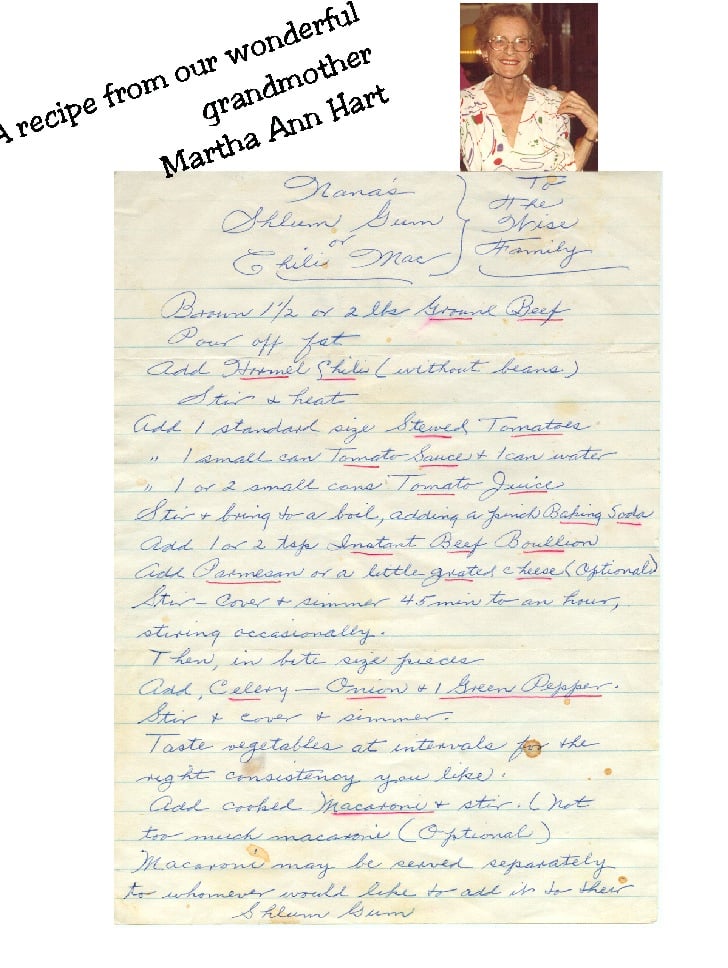
The cookbook was simple — just a 3-ring binder with each recipe page in a plastic page protector. On the cover was a simply designed cover page with our mom’s photo, and one special addition: Nana’s handwritten recipe for her Shlum Gum.
I’ve been surprised by how often I, and now my daughter, use these recipes. In fact, I use it more than any other cookbook on the shelf.
When my niece bought her first home last month, I decided to update the family cookbook with new additions. With help from AI (I’ll explain that later), it came together surprisingly fast. Now our long-treasured recipes, the ones that make every holiday and family get-together memorable, have a new home in the hands of my niece.
In this article
- How Our Family Cookbook Came Together
- Why Family Recipes Get Lost
- How to Collect Recipes From Your Relatives
- How to Digitize Your Family Recipes
- How to Preserve the Stories Behind the Recipes
- Organizing and Making a Family Cookbook
- Let AI Do the Typing and Formatting
- Let AI Do The Hard Work For You! (free guide)
- Giving the Family Cookbook as a Gift
- Frequently Asked Questions
- Related Content
- Want More Useful Info From Survival Mom?
- The Final Word
Why Family Recipes Get Lost
Handwritten Cards Fade and Fall Apart
Recipe cards live a hard life. They get splattered with butter, with a drips of syrup and sauces, and tucked into a box that gets shuffled from cabinet to cabinet. Pencil and ink smudge and fade, and the most popular card is usually the one with a grease stain right over the oven temperature. Those cards are treasures because of the handwriting, but they make a poor long-term storage system.

The Cook Who Measures by Feel
Many of the best family cooks never used a written recipe at all, and I’m one of those! We add flour until the dough looks right, a handful of this, and a splash of that, and we “just know” when the gravy is ready by the way it coats the spoon. When you ask how we make it, lots of times we shrug and say, “Come and watch me next time!” The knowledge is real, but unless someone writes it down, it leaves the family when the cook does.
Moves, Downsizing, and Estate Cleanouts
When a parent or grandparent downsizes, moves into assisted living, or passes away, the family often has to empty a house in a matter of weeks. In that rush, a shoebox of old recipe cards or a stained church cookbook full of handwritten notes in the margins can easily end up in a donation bag or the trash. When you’re grieving and the house has to be empty by the end of the month, a shoebox of recipe cards doesn’t get much attention, which is exactly why it helps to gather the recipes now, while everyone can enjoy the process together.
How to Collect Recipes From Your Relatives
Gathering recipes works best when you spend time with the people who cook. Here are a few steps to get started.
- Make a wish list first. Write down the dishes your family talks about most and who makes each one, so you know whom to ask and what to ask for.
- Photograph every original card. Take a clear, well-lit photo of the front and back of each handwritten card before you do anything else, so the handwriting is saved even if the card isn’t.
- Film the cook making the dish. Ask Grandma, or whoever makes it best, to let you film while she cooks, and measure what she uses as she goes.
- Record the stories with a voice memo. Set your phone on the counter and let it record while you talk, because the memories come out more easily while someone is cooking.
- Ask specific questions. Instead of asking for the recipe, ask about the pan, the brand of flour, how long it really bakes, and how she knows when it’s done.
- Write it down the same day. Type up the recipe, your measurements, and the story while everything is fresh, then send it to the cook to check.
Use Holiday Get-Togethers to Your Advantage
The holidays bring the cooks, the dishes, and the people who remember them into one kitchen, which makes them the easiest time of year to collect recipes. Before the get-together, let your relatives know you’re putting together a family recipe collection and ask them to bring a copy of their favorites and most popular ones. If you have any on your own personal wish list, ask for those specifically.
When I worked on this project I used AI (ChatGPT, specifically) to help, and I only needed to take a photo of each recipe with my phone camera. It couldn’t have been easier, and I highly recommend that process.
Alternately, you can set up a table where everyone in the family can place their recipes and then copy the ones they want to save. This is a simple and inexpensive memory-maker because inevitably, it will lead to talk of favorite meals and traditions. You can also see my ideas for celebrating the holidays on a tight budget, because many of the most cherished traditions are the least expensive.
Film the Dish and Measure What She Uses
This tip is the one I’d recommend most because you get a priceless video of a loved one doing her thing over the kitchen stove and instructions for making a recipe you want to save. When a cook says she uses “about a cup” of flour, place a measuring cup or a kitchen scale nearby and measure each handful before it goes into the bowl. A short video captures the things a card never will, like how thick the batter looks, how she folds the dough, or how she crimps the edge of a pie crust. Be sure to also jot down the ingredients, measurements, and instructions to go into your family cookbook.
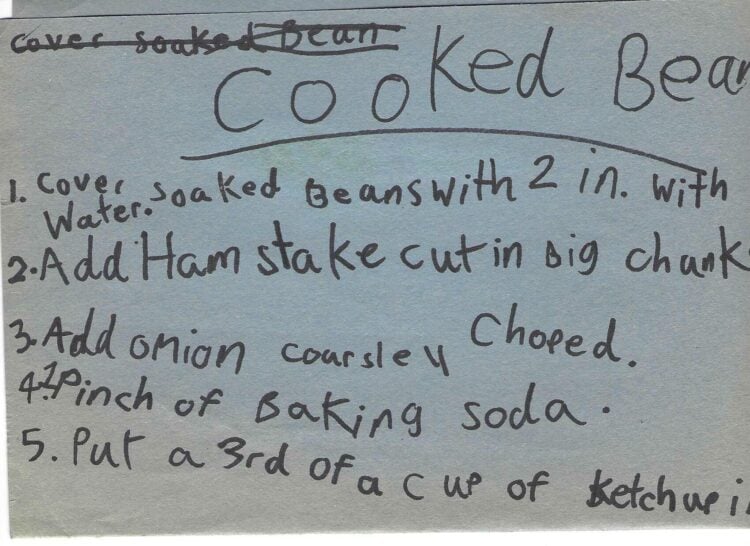
About twenty years ago, my daughter did this when my mom made a batch of her famous beans!
Ask Better Questions
When you ask general questions, you tend to get general answers, so it helps to be specific. Try questions like these, and write down every answer, even the small ones.
- What size pan do you use, and is it glass or metal?
- Which brand of flour, butter, or canned soup do you buy, and does it matter?
- How do you know when it’s done, by the time, the color, or the smell?
- Who taught you to make this, and did you change anything from the way they made it?
- When do we always make this dish, and who asks for it most?
- What goes wrong when someone else tries to make it?
My mom’s meatloaf is the best, ever, but often when I’ve made it, mine doesn’t turn out quite right. So, I finally learned her secrets when I asked, “What type of breadcrumbs do you use? Do you mix the ingredients with your hands or a spoon?” (Hands, always!)
Lots of times, the secret has less to do with tiny details like these than the list of ingredients or the oven temperature.
How to Digitize Your Family Recipes
Once you have the cards, photos, videos, and notes, the next step is to turn them into something you can share and protect. You don’t need special equipment, and you can work through a few recipes at a time.
Scan or Photograph the Originals
I started my cookbook update by manually typing in each recipe. That got tedious, as I was adding at least 25 new recipes! My husband said, “Why don’t you just take a picture with your phone, and see if ChatGPT can use the image for the recipe page?”
Bingo! That changed the project entirely from one I was dreading to one that was impossibly fast and finished.
I simply used the camera on my phone to do this, but alternatives can be a free or low-cost scanning app on your phone or a scanner. All will flatten the image, sharpen the text, and then save each recipe as a PDF or image. Photograph or scan both sides of each card, since many cooks wrote notes, dates, or a name on the back. Name each file clearly with the dish and the cook, such as the recipe name followed by the relative’s name, so you can find it later.
What’s especially lovely about this system is that everyone in the family can do this. They only have to take a picture with their phone and then send the photo on to you.
If you have treasured recipes with handwritten notes, one day that handwriting will be remembered and treasured, so in the finished cookbook, include those actual scanned/photographed images.
Type Them Up in a Shared Document
Handwriting is beautiful, but a typed version is easier to read, search, and print. Create a shared Google Doc or a Google Drive folder for the family, with one document per recipe or one folder per branch of the family. I invited most everybody in the family, including a couple of in-laws. Your collection might be family and friends.
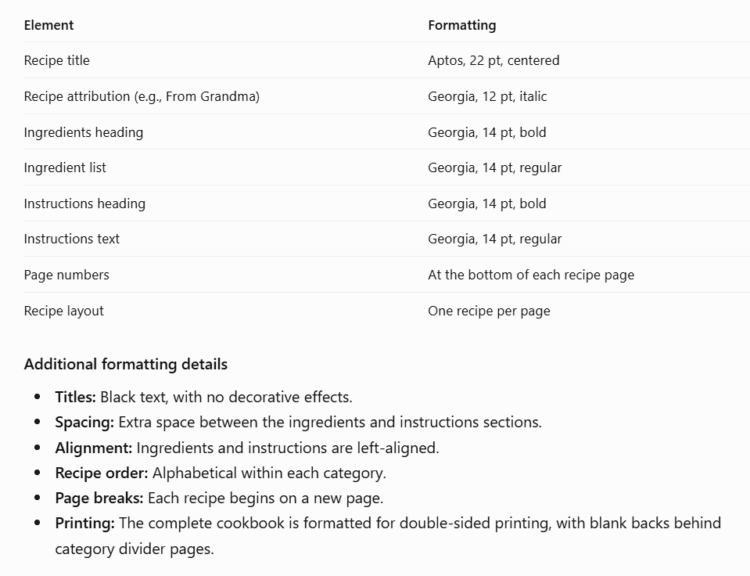
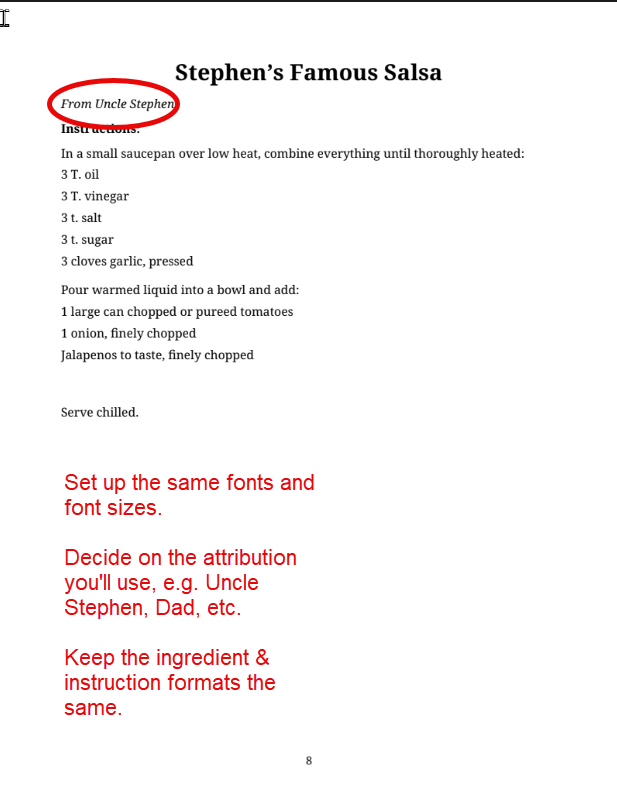
Type each recipe in a consistent format with a title, recipe attribution (who it’s from), ingredients and measurements first and steps second.
This is the formatting I set up in Google Docs for our cookbook, making sure every recipe was consistent.
Back It Up in More Than One Place
A single computer or a single phone isn’t the safest storage for something this important. Keep a copy in a cloud folder, a second copy on a USB drive or external hard drive, and share a copy with at least one relative. Once my cookbook was completely finished in Google Drive, I sent the shared link to everyone, whether they contributed or not!
This is the same thinking behind my Grab-and-Go Binder, and you can even tuck a USB drive of family recipes and photos in with your important papers.
Keep Printed Copies, Just in Case
Here’s where a little self-reliance comes in. Accounts get locked, passwords get forgotten, files get corrupted, and devices fail at the worst possible moment.
A printed copy on the kitchen shelf, in a 3-ring binder, will still be there when the power’s out or the internet’s down, and it doesn’t depend on anyone remembering a login. If you want to raise kids who value these skills, my post on creating a culture of self-reliance in your family is a good companion to this project.
How to Preserve the Stories Behind the Recipes
A recipe tells you how to make a dish, but it’s the story behind it that tells why the family keeps making it. Years from now, your grandchildren may care just as much about who made the pie, and for which occasions, as they do about the amount of sugar it calls for.
Add a short story page next to some of the recipes. Include who made it, where it came from, the occasions when it was served, and any funny or tender memories that go with it.
If you’ve made a video or just talked about the recipe, transcribe the best parts word for word, because the way a person talks is part of who they are. If you have old photos of the cook in the kitchen or of the dish on a holiday table, scan them and place them alongside the recipe.
Organizing and Making a Family Cookbook
When you have a good collection, it’s time to put it all together. Start by sorting the recipes into simple categories, such as breakfast, main dishes, sides, breads, desserts, and holiday favorites. The categories I chose:
- Appetizers & Dips
- Soups & Salads
- Main Dishes
- Side Dishes
- Desserts
- Holiday Sweets
Some families prefer to organize by person instead, with a section for each grandparent, aunt, or cousin, which works especially well when the stories are the heart of the book.
The DIY Binder
A three-ring binder with sheet protectors is the most flexible option, and it’s the easiest place to begin. You can print the typed recipes, slip the photos of the original cards next to them, and add new recipes whenever someone shares one. Sheet protectors keep spills off the pages, and tabbed dividers make it easy to find what you need. A binder is also simple to copy, so each household can have its own.
Printing was the easiest step of all. I attached the cookbook file to an email, sent it off to the nearest FedEx location, and the printing was ready for pick-up that afternoon.
The cost of the entire cookbook, from the binder to plastic page protectors, and the printing cost about $60. $45 was for the printing.
Print-on-Demand Cookbooks
If you want a finished book that feels like an heirloom, print-on-demand services let you design a cookbook online and order as many copies as you need. Some are general photo book companies, and others are made specifically for family cookbooks, with templates for recipes and story pages.
I’ve personally used Lulu, although not for a cookbook, and their quality and customer service are excellent. Another company many food bloggers use is Vervante.
Prices vary by page count, cover type, and the number of copies, so compare a few services and order a single proof copy before you order for the whole family. A printed book looks beautiful on a shelf, though it’s harder to update, so many families keep a binder for new recipes and print a new edition every few years.
Our family cookbook is in a 3-ring binder. It’s cost-effective and easy to change with new recipes.
Let AI Do the Typing and Formatting
I used ChatGPT for a lot of this project, and it made the whole process so much easier. I took a photo of each recipe with my phone and handed the photos over to AI. It typed up every recipe using my formatting system and filed each one in the section I’d picked.
It also built a table of contents and numbered every page. It even added divider pages between the sections. It would have taken me hours to do this manually. In fact, at one point I decided to add a last-minute recipe just before printing, and ChatGPT added it in seconds, renumbered all the pages, and then created an updated Table of Contents.
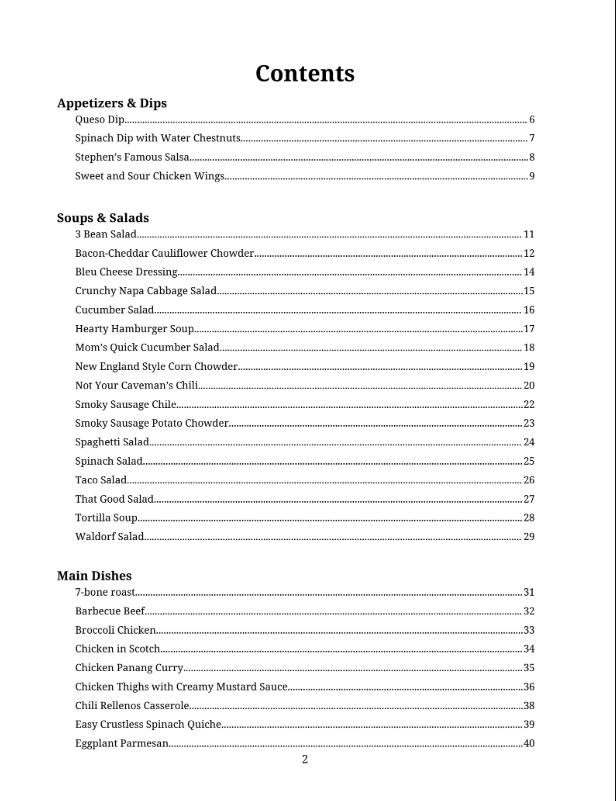
The biggest perk shows up later. When the recipes are saved in a digital file, adding or changing one takes a few minutes. Right now I’m making a version of the cookbook for my daughter and adding the recipes that have become Bedford family favorites. My sisters and sister-in-law have access to the Google Doc with the entire finished cookbook, so they can add, edit, or remove recipes for their own copies whenever they like.
A few more ways AI can help:
- Proofread against the original card. AI can misread faded handwriting, so check the amounts, like 1 tsp vs. 1 Tbsp, and the oven temps before you print.
- Ask it to fill in the gaps. Old cards often just say “a can of soup” or “bake until done.” AI can suggest modern can sizes and bake times, and you can note them in brackets so Grandma’s original wording stays put.
- Scale recipes up or down. Have it halve a recipe for a new household or double one for holiday crowds.
- Make a shopping list. Ask for a combined grocery list for any recipes you plan to cook together.
- Turn stories into captions. Tell AI what you remember about a recipe, and it can tidy that into a short note for the top of the page.
- Keep the photos. Save your original phone photos in a folder next to the Google Doc. If something looks off later, you can go back to the source.
Let AI Do The Hard Work For You! (free guide)
Typing up 25 recipes was a project I kept putting off, until I started snapping photos and letting AI do the typing. This free step-by-step guide walks you through the whole process, with copy-and-paste prompts for formatting every recipe, catching errors in measurements, and then building the table of contents in seconds.
Giving the Family Cookbook as a Gift
A family cookbook is one of the most meaningful gifts you can give, and it often means the most to the people who are hardest to shop for. When my niece bought her home, I wanted to give a housewarming gift but had no idea what she might want or need. A family cookbook, an heirloom, really, was one of those “just right” gifts.
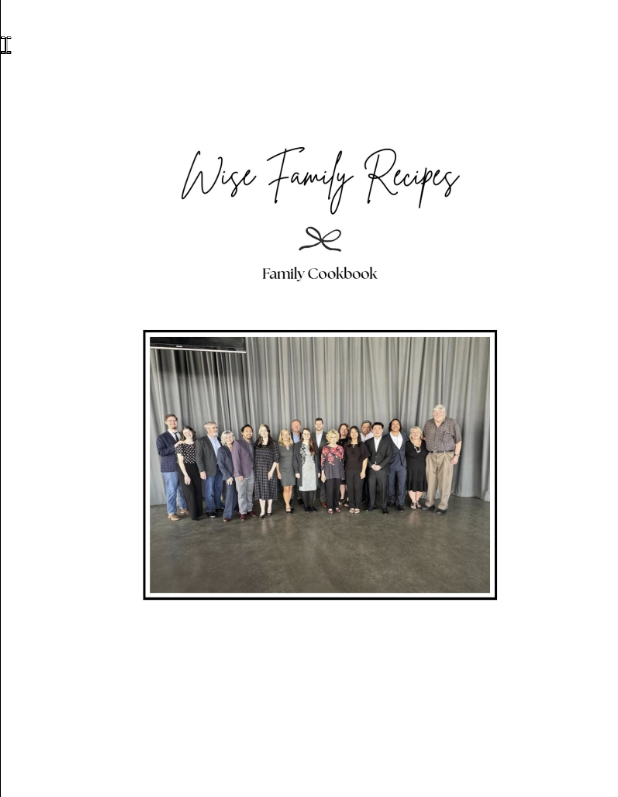
Consider giving copies to grown children setting up their first kitchens, to newlyweds joining the family, or to the relatives who shared their recipes in the first place. For the cooks who contributed, seeing their recipes and their words in print makes the difference between a copy of a random recipe and a family heirloom.
You can make the gift even more personal by pairing it with a dish from the book, a wooden spoon, or a handwritten note about why that recipe is special to you. If the full cookbook isn’t ready by the holidays, a single framed recipe card in the cook’s handwriting, or a small booklet of five favorite recipes, is a lovely start, and it lets everyone know a bigger book is on the way.
Frequently Asked Questions
Watch them cook and measure each ingredient before it goes into the bowl, using measuring cups or a kitchen scale. Film the process and ask how they know when it’s done, then write everything down the same day. In my case, it was my very young daughter who did this while her Grandma made a pot of beans. If you don’t live near the cook, hand this task to someone who does.
The easiest way is to take a photo with your phone’s camera. Doing this saved me hours of time. You can also use a phone scanning app or a flatbed scanner to capture both sides of each card, then type the recipe into a shared document or instruct AI to add the recipe to your digital files. Keep the image of the original so the handwriting is preserved.
Keep copies in at least two or three places, such as a cloud folder, a USB drive or an external hard drive. I shared the Google Drive link with everyone in my family.
A binder is inexpensive, easy to update, and simple to copy. A print-on-demand cookbook feels like an heirloom but is harder to change and costs a lot more.
Add who made the dish, where it came from, the occasions when it was served, and favorite memories. Photos of the original card and of the cook make the collection even more meaningful.
Related Content
- Why Old Cookbooks Are Worth Collecting and Where to Find Them Cheap
- How AI Can Help You Prep: Prompts and Real-World Uses
- Great Depression Meals: What Families Ate to Get By (60+ Depression-Era Foods)
- What Great Depression Women Knew That Most of Us Have Forgotten
- How to Make Delicious Soup Without Using a Recipe
Want More Useful Info From Survival Mom?
The Final Word
Saving your family’s recipes honors the people who loved and fed us and passes that love along to the people we feed. That second and third generation, and beyond. This is a project that can be handled by a single person or can become a group project. Either way, start with listing the best-loved recipes that show up time and again every year, and begin asking for copies. A few years from now, someone you love will open that book, smell a familiar dish in the oven, and feel connected to a grandparent they may never have met.