
What did Christmas look like when a family had almost no money? I went back to stories readers have sent me over the years, the ones their parents and grandparents told about Depression Christmases. One little girl’s only gift was a fresh red apple. One dad waited until closing time on Christmas Eve to buy the tree nobody else wanted. If money’s tight this year, there are a few of their traditions you can borrow.
The Gift of A Bright Red Apple
Around 1967, a second-grade teacher stood in front of her class and told them about Christmas during the Great Depression. She told her students, all comfortably middle-class Americans, a story about a Christmas she had experienced as a little girl decades earlier. Growing a little emotional, she recalled the year she received just one Christmas present, a fresh, red apple. When she unwrapped it, she was so overjoyed that she cried.
One of the kids in that classroom was one of my readers, Lisa D. She still remembered the look on her teacher’s face, and the story hit close to home because her own family was struggling at the time. “The daily trials we lived in our home when I was a small child were just like the days of the Depression,” she wrote.
Even though she was young, she knew that money was tight, and it was going to be a bare-bones Christmas.
Lisa’s grandmother had been a child of the Great Depression, and she had learned what one determined woman can do to keep her family fed and together, and that included Christmas.
Families like hers celebrated anyway. They made the holidays out of whatever they had on hand. The stories below come from readers whose parents and grandparents lived through those Christmases, along with some history I dug up along the way.
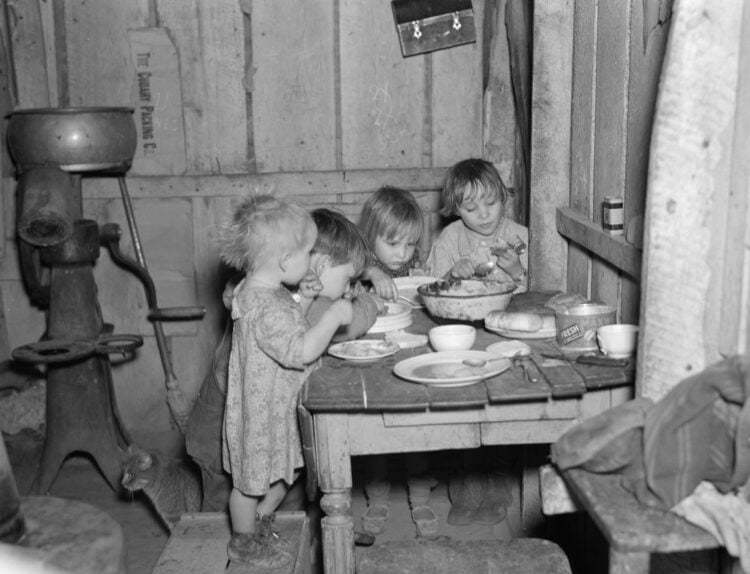
Christmas: “Santa’s a Little Short This Year, Too”
Parents in the 1930s had a gentle way of lowering expectations. Santa Claus, they told their kids, was having a hard year, too. Don’t expect too much.
Kids are the same everywhere, so of course, they hoped anyway. The arrival of the Sears catalog kept that hope fed and growing. Children pored over those pages, circling dolls, trains, and cowboy outfits they knew they probably wouldn’t get. In 1933, at the very bottom of the Depression, Sears mailed out its first Christmas catalog, a book of 87 pages with 25 of them devoted to toys. It became the famous Wish Book, and looking and daydreaming didn’t cost a dime.
Then, kids wrote to Santa, and some of those letters turned up in local newspapers. In December 1934, the Minot Daily News in North Dakota printed letters from area children.
Six-year-old Dolores Donahue asked for a doll for herself and one for each of her two little sisters. Richard Ehr asked for a truck and a football, then remembered to add a dress for his mother and gifts for his brother and sister. The Welch brothers, Gene, Buddy and James, opened their letter by asking Santa to “remember the rest of the family” before they got around to their own list.
Santa represented abundance, cheer, and generosity even though Great Depression kids knew, deep down, there would be little underneath their Christmas tree.
The 25-Cent Tree
One smart dad had a strategy every year and planned ahead. He waited until Christmas Eve, right around closing time, when he’d walk down to the tree lot and pick through the leftovers nobody else wanted. He usually paid about a quarter for the family tree, but I imagine that when he walked through the front door with that tree, he must have felt like a hero to his kids.
He wasn’t the only one with that idea, and in the worst years the lots couldn’t give trees away. On Christmas Eve 1931, The New York Times reported that Christmas trees were “a glut on the market.” More than 120 carloads of trees remained unsold. It wasn’t a shortage of Christmas trees that left families without a tree that year, but a shortage of money.
That same day, the construction crew digging the foundation for Rockefeller Center pooled their money and bought one of those leftover trees. They stood it up in the mud of the job site and decorated it with strings of cranberries, a few tin cans, and paper garlands their families made at home. That scrappy little tree was the very first Rockefeller Center Christmas tree.
Nearly every Depression-era tree was trimmed with homemade decorations. Families strung popcorn, cut stars and shapes from cardboard, and covered them in saved foil. Scraps of tin were bent into ornaments with holes punched in the metal to create designs that caught the light.
Paper chains were the big one. A few sheets of red and green construction paper cost about a nickel. Mom mixed up a little flour and water for paste, and the kids spent an afternoon gluing loops together until the chain was long enough to wrap the whole tree.
Even more magical were hand-cut paper snowflakes from a sheet of white paper. Those were hung in doorways, from ceilings, and of course, on the Christmas tree. You know, in very simple times, decorations like these really do feel magical, especially in the imagination of a child.
Not every family had even that much, though. Carmelita Lee’s mother grew up the daughter of a Florida tenant farmer, one of thirteen children. Most years their “tree” was a few sprigs of Florida pine. “Not an attractive Christmas tree,” Carmelita admits. I suspect those kids didn’t care one bit, for reasons you’ll see in a minute.
What Was Under the Tree
When there was a gift under the tree, it was usually something the child needed anyway, like a new coat or a pair of shoes that fit. In cold country, caps and mittens for the walk to school or a new outfit for church.
A dad with a few tools, some scrap lumber, and a few skills made gifts in the garage. One dad made a checkerboard from a piece of plywood, and another gave his kids hand tools or a wagon. You can guess what happened next. The wagon spent the rest of the winter hauling coal and firewood in and carrying ashes out, while his kids could practice using hand tools.
For a little girl, the gift of a doll was a rare and wonderful thing. By today’s standards, these dolls might have been a plain rubber baby dressed in a diaper and a little shirt. Those might have been molded on to the doll and coated with paint. Mothers and grandmothers sewed extra outfits from scraps so the doll could have a wardrobe.
Carmelita Lee’s mother didn’t get her first Christmas present of any kind until she was 12. It was a doll from the catalog. Twelve years of waiting for one doll. I hope she loved it to pieces.
An Orange in the Toe of the Stocking
If you’ve ever found an orange in the toe of your Christmas stocking and wondered why, the Depression generation is a big part of the reason.
These days we buy oranges year-round without a second thought. In the 1930s, fresh fruit wasn’t readily available everywhere, especially in winter. Oranges were pricey and felt almost exotic in a Northern winter, and the Depression made the tradition stick. Plenty of families couldn’t afford store-bought gifts, so an orange and a handful of walnuts in the shell were the stocking.
Remember Carmelita Lee’s sprigs of Florida pine? “Most years for Christmas ‘if we were lucky that year’ they would get an apple and an orange that would be hanging on a few sprigs of a Florida pine,” she wrote. That was the tree and the presents all at once. An apple and an orange, if they were lucky.
The love of those oranges stuck around for a generation, in more ways than one. Marlene Kallstrom-Barritt grew up in the country with parents shaped by the Depression, and Christmas oranges meant something very specific at her house. “We looked forward to Christmas as the wrappings on the ‘Japanese’ oranges were lots nicer to use in the outhouse rather than the mail-order catalogue,” she told me.
Back then, a lot of business owners saw themselves as something like a father figure to their workers. They figured their responsibility didn’t stop at the factory gate. It followed their employees home. At Christmas, that might mean a turkey or ham, a basket of groceries, or a box with oranges and hard candy for the kids.
Some city governments did the same for their workers. In good years, those gifts were a nice holiday gesture, but during the Depression, when families were stretching every penny, a Christmas ham from Dad’s boss might have been the most welcome gift of all.
Christmas Dinner and Something Sweet
The big Christmas meal looked a lot like ours does today. When a family could manage it, there was turkey or ham, potatoes, vegetables and cranberries, with something sweet at the end. The difference was the work behind it. Most of that dinner was grown and canned at home or saved up for weeks ahead of time.
When the budget wouldn’t stretch to a full spread, women got creative with dessert. Depression cake, sometimes called war cake, skipped the butter, eggs and milk entirely and still came out moist and chocolate-y. Mock apple pie used crackers in place of apples, and plenty of people swore they couldn’t tell the difference. (You can find more of these in my Great Depression meals article.)
The Christmas Box
For some families, Christmas dinner came in a box delivered on the front porch. Sometimes it arrived anonymously, other times it arrived in the arms of smiling neighbors or the church family.
Many towns had a Community Chest, a local fund that pooled donations and handed them out to people in need. It was the forerunner of today’s United Way. There were 39 of them in 1919 and 353 by 1929, just as the crash hit and the need exploded. It was a way for the people of a community to distribute what little they had to families who had even less.
Plenty of Depression families were adamant about never accepting charity, though. Even so, a lot of them made room for the Christmas food box, whoever delivered it. Getting one was a big deal, and the whole family gathered around the kitchen table to watch it unpacked, one item at a time.
One family remembers their food box included a fresh turkey and real butter, which was an especially big treat. Along with those, came whipped cream pies, jellied cranberry sauce, yams and dinner rolls, with nuts in the shell, hard candies, oranges and peppermint sticks tucked in around the edges. Depending on how clever Mom was at stretching food, that one box could feed the family for several meals, sometimes more.
Giving When You Had Almost Nothing
This part of the story surprised me most. The people with the least were often the quickest to share.
One household I read about had something rare in those years — three family members with jobs, which meant three paychecks. At Christmas they packed up boxes of food and carried them over to families who had nothing. I kept running into the same stories in emails from readers and in my research. Even when they barely had enough, people said sharing what they had was the part they remembered.
Carmelita Lee’s grandmother didn’t have three paychecks. She didn’t even have one. She was a tenant farmer’s wife sewing clothes for thirteen children out of other people’s castoffs. She still took baskets of food from her garden to “the poor people,” and she kept a cardboard sign in her window letting hungry travelers know they could eat at her table.
Carmelita says the wealthier families, the ones her aunts and uncles called “the shoe people” because they had shoes, rarely put that sign in their windows. The poorer folks did. Hobos and sometimes whole families came to the door. They washed up at the old pump outside, usually prayed with the family, then ate and often bunked out in the barn. Carmelita’s mother remembered her grandpa keeping a shotgun over his shoulder, and she also remembered never feeling afraid of these desperate strangers.
Generosity sometimes came anonymously, too. A week before Christmas 1933, a small ad ran in the newspaper in Canton, Ohio. A man calling himself “B. Virdot” offered cash gifts to families in distress, no names published, no strings attached. All they had to do was write and tell him their story.
So many letters poured in that he cut each gift in half so he could help twice as many people, mailing $5 checks to 150 families. Nobody knew who he was until 2008, when his grandson, journalist Ted Gup, opened an old suitcase and found the letters. Mr. Virdot was a local clothing store owner named Sam Stone who had known hard times himself.
One of those letter-writers had a nine-year-old daughter named Valerie. Decades later, she still remembered what she got for Christmas in 1933, an orange and a little powder-blue change purse. (There’s that Christmas orange, again!)
Staying Warm and Getting Out
Winter holidays came with a cold-weather problem in most parts of the country. Coal and heating oil cost money, and money was the one thing few people had, but intense cold could become deadly, so desperate times called for desperate measures. Families stuffed straw beneath their rugs for an extra layer of insulation between their feet and a drafty floor. It’s a trick I’d keep in mind for a long winter power outage, honestly.
The best holiday entertainment was free. Churches put on nativity scenes and Christmas pageants, with kids in bathrobes and dish-towel headdresses playing shepherds and the little ones wore a tin-foil halo over their heads. Families who had a horse and a little snow went on sleigh rides. None of it cost a dime, and I’d bet those were the memories people held onto longest. Even now, I’ll bet there are old-timers who still remember those winter sleigh rides.
Christmas, Far Apart
One story I keep thinking about is Don Hartwell’s Christmas, from Timothy Egan’s book, The Worst Hard Time.
By the late 1930s, years of drought and debt had pushed the Hartwells to the point of bankruptcy on their Nebraska farm. Verna took a job as a maid in a doctor’s house in Denver, earning about $40 a month and mailing Don $5 every two weeks. He stayed behind on the farm alone. After decades of marriage, they now lived hundreds of miles apart.
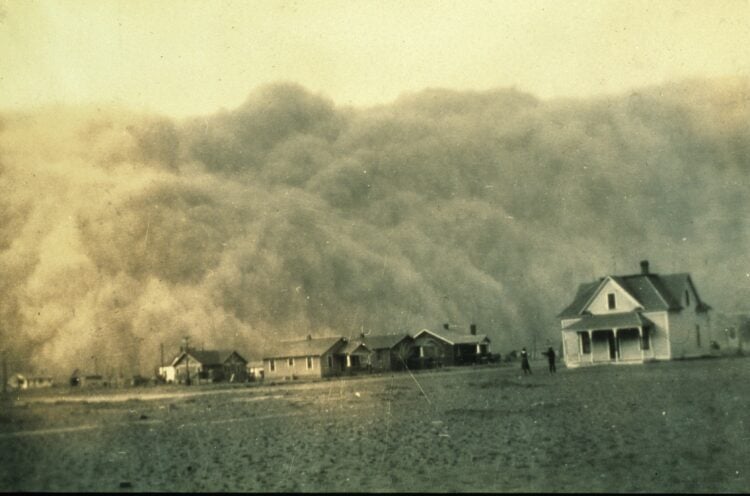
Verna was able to finally come home for Christmas, and on Christmas Eve, 1938, Don raked the north side of the yard in the morning and swept and dusted the house in the afternoon. Then, he wrote in his diary, “I trimmed the tree and lighted it in the evening, so it was lighted when Verna came up from the depot.” She got home at 10 that night and stayed about a week before going back to Denver.
Many families were apart for months and even years as fathers and sons had to travel miles away just to find a job. At Christmas-time, the feelings of loss and isolation must have been particularly heartbreaking.
What We Can Borrow This Christmas
You don’t need a Depression to celebrate the way they did, and a lot of us are feeling the money-pinch this year anyway, so here are a few ideas to borrow:
- Start a Christmas cash envelope now. Banks used to offer “Christmas Club” accounts where you deposited a little every week and got it all back in time for holiday shopping. Christmas might be right around the corner, but is there any “found money” hiding around the house in the form of a gift card never used or some cash in the sock drawer? For next Christmas, make this a weekly or monthly goal.
- Give gifts that get used. Warm wool socks or a sturdy flashlight for the car make perfectly fine gifts. The Depression generation never apologized for a practical present, and neither should you.
- Make something by hand, and start this week. A knitted or crocheted hat or a batch of homemade candy can come together pretty quickly. My mom’s English Toffee recipe is crunchy, rich, and has never been turned down by anyone receiving it!
- Decorate for almost nothing. Popcorn garlands and paper chains still make a tree look like Christmas. Hand the kids a stack of construction paper and see what happens. Have a snowflake-making contest, and then create a winter wonderland inside by hanging them from strings in doorways.
- Put an orange in the toe of every stocking. Then tell your kids or grandkids why it’s there.
- Make up a box for someone else. Fill a box with a holiday meal and drop it on the porch of a family who’s struggling or a widow down the street. It’s the best Christmas tradition in this whole article.
If you’re running on empty this year, start with one small thing, an orange in the stocking or a box on someone’s porch.
Plan Your Own Make-Do Christmas
I made a free Make-Do Christmas Planner to help you put these ideas to work: a four-week countdown for a cash envelope, handmade gifts, and the simple traditions you just read about.
Want More Useful Info From Survival Mom?
More From My Great Depression Series
- What Great Depression Women Knew That Most of Us Have Forgotten
- The Real Reason Some Families Survived the Great Depression and Others Didn’t
- Growing Up During the Great Depression: What Kids Did and Why It Mattered
- Great Depression Home Remedies: How Families Stayed Healthy
- What the Great Depression Can Teach Us About Cooking on a Budget
Related Content For a Make-Do Christmas This Year
- How to Celebrate the Holidays on a Tight Budget (Without Losing the Magic)
- Just in Case Grandma’s Recipes Disappear: How to Save Family Recipes
- Stock Your Food Pantry with These Holiday Bargains
- 52-Week Savings Challenge 2027: Save $1,378 by Year’s End
The Final Word
I keep remembering that red apple, how much it meant to a little girl on Christmas morning and how cried because she was so happy. Decades later, one of her students still remembered the story and how her teacher, that little girl, shared it.
Most of us will never have a Christmas that lean, and I hope we never do. Still, the families in these stories had something I want for my own family. They knew how to make a good Christmas out of very little, and they always made room at the table for someone else. That’s what makes a lifelong Christmas memory — the togetherness, the generosity, and the spirit of the season.
Some of the links in this post may contain affiliate links for your convenience. As an Amazon Associate, I may earn a small commission from qualifying purchases without any increase in price to you.