
Bank and payment outages caused by software glitches, botched updates, and cyberattacks happen more often than most people realize. Your money is almost always still there, but you might not be able to reach it for a few hours or a few days. This guide walks you through figuring out what’s going on, getting through the outage without missing a bill, and setting up a simple backup plan now so the next one barely touches your family.
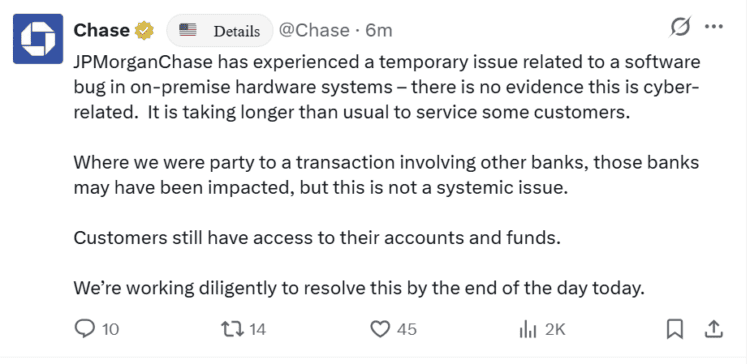
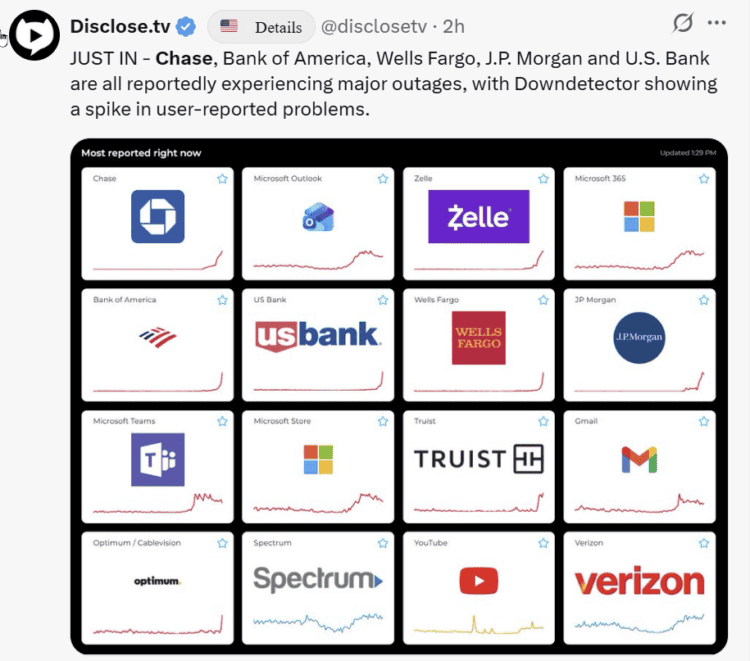
In a digital world, where everything flows smoothly, from passwords to websites and ordering online, a sudden disruption causes disbelief and confusion. Right now, a number of banks are offline, including big ones like Chase and Wells Fargo.
A few days ago, an airline’s computer systems went down and stranded travelers all over the country. Neither one was the end of the world, but both were a reminder of how much of daily life now runs through a server somewhere that you’ll never see. It doesn’t help when the explanations are confusing and conflicting.
So here’s my question for you. If you woke up tomorrow and your bank app showed a balance of $0 (or wouldn’t load at all), how would you buy groceries this week?
During Hurricane Beryl, we went 11 days without power. We stopped by Lowe’s to buy a few supplies, and not only was the line down the sidewalk, but employees were yelling, “Only if you have cash. Our machines are down.” A power outage and a bank outage do the same thing to your wallet. The money is there. You just can’t get to it.
Before we go any further, I want to be very clear about something. This is not a post about bank runs or financial collapse. When a bank’s website goes down, your deposits are still there and still insured by the FDIC (or the NCUA at a credit union). The problem is access — taking out cash, paying bills, checking account balances — and access is something you can plan for.
What a “Money Blackout” Can Look Like
When you hear of an outage or “software glitch”, it’s important to know the different ways this can afffect you.
- Your bank’s app or website is down. You can’t log in, or you log in and see the wrong balance. Your debit card and the ATM might still work fine.
- A card network goes down. If Visa or Mastercard has a problem, cards fail everywhere, no matter which bank issued yours.
- A bank or one of its vendors gets hacked. Ransomware attacks can freeze a bank’s systems for days. Remember the CrowdStrike mess in July 2024? One bad software update from one company knocked out airlines, hospitals, and banks all at the same time.
- The store’s system is down. Your bank is fine, but the registers or card readers at the grocery store aren’t working. These are store or business specific.
- Your own account gets frozen. When systems glitch, fraud alerts can trigger on perfectly normal purchases and lock your card.
- The power or internet is out where you live. No power means no ATMs and no card readers. This is the one I’ve lived through most often.
Most of these get fixed within hours. A few drag on for days. Any can happen at any time, but you only need a plan that covers all of them.
The First Few Hours: Don’t Panic, Check Facts
When the news first hit about the big bank outage, it first began on a small scale but within a few hours, it was nationwide. Not being able to log in (I can’t log in to either Chase or Wells Fargo at the moment) or seeing $0 where your paycheck should be will make anyone’s heart skip a beat. Take a deep breath and then do some research to get the most important facts before you panic.
- Find out if it’s you or them. Check Downdetector.com, the bank’s official social media accounts (X will have the most up-to-date news), and the local news. If thousands of other people are reporting the same problem, it’s the bank.
- Stop trying to log in over and over. Too many failed attempts can lock your account, and then you’ll have a second problem to fix after the first one is over.
- Watch out for scammers. Criminals love an outage. They send texts and emails that look like they’re from your bank, asking you to “verify your account” through a link. When Microsoft 365 went down, hackers used it to send out fake “outage” emails to steal passwords. Don’t click. Only call the number printed on the back of your card.
- Write down what you know. Screenshot or jot down your last known balances and any transactions you were waiting on.
- Look at what’s about to come out of your account. Check your list of autopays and auto-drafts for the next few days. Those are the ones that can cause trouble when the system comes back online.
The Consumer Financial Protection Bureau’s first piece of advice is simple: contact your bank by phone, online, or in person to find out what happened and when they expect it to be fixed. Expect long hold times, and have something to do while you wait.
Ways to Get to Your Money During an Outage
This is where having a backup to your backup pays off. Try these in order.
- An ATM or a branch. Sometimes the app is down but the ATMs work, or the other way around. If a branch is open, a teller may be able to help even when online banking can’t.
- A card from a different bank. If your main bank is the problem, a debit card from a second, unrelated bank or credit union still works. This has saved me numerous times with an account at a major bank and then one at a credit union.
- A credit card. If the problem is your bank and not the card network, a credit card can carry you through groceries and gas for a few days.
- Your cash stash. This is the one that works no matter what’s down. More on how much to keep below.
- Paper checks. Your landlord, the utility company, and plenty of local businesses still take them. A check doesn’t need the internet to be written.
One warning about Venmo, Zelle, Cash App, and PayPal — they pull money from your linked bank account instantly. In many cases, that money is transferred and permanently gone. If your bank is down, they probably are too. Zelle has had its own outages that hit customers at several big banks at once.
Protect Your Bills and Your Credit
The outage itself usually isn’t what costs you money. The late fees and overdraft charges that pile up afterward are, but these can be avoided if you act quickly.
Call before the due date, not after. If a payment is due while you can’t reach your account for whatever reason, call the company and explain. Most will waive a late fee for a documented bank outage, especially if you call before the payment is late.
Keep a log. Write down the date, who you talked to, when, and what they told you. It takes two minutes and makes any later dispute much easier.
Watch for overdrafts when the system comes back. Deposits can post late while bills post on time. Transactions can show up twice. If you’re charged a fee because of the outage, the CFPB recommends asking your bank to credit it back.
If you get Social Security or a pension by direct deposit, a delayed deposit can throw off your whole month. Know which bills come out first, and keep enough cash at home to cover a week of groceries and medications. This happened recently when my mom purposely froze a credit card due to fraud and then discovered at the pharmacy that she didn’t have a way to pay! Thankfully, she had cash on hand — one reason to keep a stash of cash.
If you run a small business or side hustle, an outage can mean you can’t take payments. Keep a way to take cash or checks, and know whether your payment processor uses a different bank than you do.
If the bank announces a data breach, freeze your credit at all three bureaus (Equifax, Experian, and TransUnion). It’s free, it stops anyone from opening new accounts in your name, and you can lift it any time you need to apply for credit yourself.
Set Up Now So the Next Outage Is Just an Inconvenience
“Into each life some rain must fall,” my mom. Bank outages can be a minor nuisance, a major crisis, or barely noticed, depending on how long they last and how well you’ve prepared for this type of event.
Build a cash stash. Aim for enough to cover a week of groceries, gas, and prescriptions. Keep it in small bills, because a store with a dead register may not be able to make change for a $100. In the case of those customers in line at Lowe’s, people who had cash in their wallets got first dibs at the few generators in stock. For your own stash, start small if you need to. A few dollars a month adds up faster than you’d think.
Put cash in the car, too. I’ve been saying this for years. Keep at least $20 in small bills in each glove box. It has bailed out more than one family member.
Bank in two places. Keep a second checking account at an unrelated institution, like a local credit union, with a little money in it and its own debit card. Today, I can’t log in to Chase or Wells Fargo, but my small, regional bank isn’t having any issues.
Make a paper money binder. Include your banks’ phone numbers, a list of every autopay and the date it comes out, and contact numbers for your creditors. Store it somewhere secure, like your Grab-n-Go Binder.
Keep a few checks on hand. Even if you haven’t written one since 2015.
Remember that your pantry and preps are a financial buffer. A stocked pantry, a full gas tank, and refilled prescriptions mean that a few days without access to your money is an inconvenience, not a crisis.
Before the Next Outage Checklist
- Start a cash stash at home and add to it each month
- Put at least $20 in small bills in each vehicle’s glove box
- Stash some small bills in your emergency kit
- Open a backup account at a second, unrelated bank or credit union. Find out if they have a minimum deposit requirement as you don’t want a monthly fee on an account you may rarely use.
- Copy the contents of your wallet, front and back
- Collect copies of all your bill-paying accounts
- Print a list of your banks’ and creditors’ phone numbers
- Write down every autopay and the date it comes out
- Order a few paper checks if you’re out
- Update your Grab-n-Go Binder with all of the above
After It’s Over
When everything comes back online, don’t just breathe a sigh of relief and move on like it never happened.
- Go through your account line by line. Look for duplicate charges, missing deposits, and fees you didn’t cause.
- Report errors quickly. Under federal rules, you generally have 60 days from the date your statement was sent to report an error on an electronic transfer. Don’t wait until next month to look.
- Ask for refunds. Overdraft and late fees caused by the outage are fair game to dispute.
- Keep an eye out for scam follow-ups. Fraudsters know who was affected and will send “refund” and “security update” messages for weeks afterward.
- Check your credit report if a payment went out late, and dispute anything that’s wrong.
- Decide whether this bank still deserves your main account. One outage happens. Repeated outages are a pattern.
Frequently Asked Questions
Yes. An outage affects your ability to see and move your money, not the money itself. Deposits at FDIC-insured banks and NCUA-insured credit unions are still covered up to the insurance limits. When the system comes back, your balance should be right where you left it. If it isn’t, that’s when you call the bank and start keeping notes.
Start with enough to cover a week of the basics: groceries, gas, and any prescriptions. Keep it in small bills. If that feels like a stretch, start with $20 and add a little every month. Any amount of cash is better than none when the card readers go dark.
It’s very unlikely. Banks keep backups of their records, and a ransomware attack usually locks up systems rather than erasing balances. What an attack can do is keep you from reaching your money for a few days, and that’s why a cash stash and a second account are so useful.
You might, but you can usually get them waived. Call the company before the due date if you can, explain that your bank had an outage, and write down who you spoke with. Ask your bank to refund any fees it charged because of its own outage.
No. That’s how an inconvenience turns into a bank run. Your money is safer in an insured account than in a coffee can. Keep a reasonable cash stash at home all the time, so you never feel the need to rush the bank in the first place.
Related Content
- 52-Week Savings Challenge 2027: Save $1,378 by Year’s End
- How to Prepare for an Internet Outage
- How to Survive a Power Outage: A Day-by-Day Plan for 3 Days to 3+ Weeks
- The 30-Minute Family Cyber Lockdown: How to Protect Your Bank, Wi-Fi, and Identity Without Panicking
- Grab-and-Go Binder for 2026: Updated Family Emergency & Digital Checklist
- Frugal Living Tips That Got Our Family Out of Debt
Want More Useful Info From Survival Mom?
The Final Word
During Beryl, the people in my town who had cash on hand to pay for things when ATM machines were down, got what they needed quickly. A bank outage works the same way. You can’t stop a software update from going wrong or a hacker from hitting a bank’s vendor. You can make sure your family has everything it needs — groceries, gas, and a way to pay the bills — while someone else fixes it.
Somewhere right now, a hacker is using AI to poke at thousands of bank accounts and businesses at once, and he’s probably not even wearing pants. I can’t do anything about him. But I can make sure that when he gets lucky, my family barely notices. He only has to get lucky one time; we have to be on guard all the time.