
Forecasters expect this El Niño to be one of the strongest on record, and NOAA gives high odds it lasts into early 2027. What that means depends on where you live: a wetter, stormier South, Gulf Coast, and Southwest, and a milder, drier northern tier, though a mild forecast doesn’t rule out a sudden Arctic blast. It’s also expected to push up prices on coffee, chocolate, and other imported foods. Below, I break down what to expect in your region, how to get ready for floods, ice storms, power outages, nor’easters, and Northwest drought and wildfire, plus a home, car, and pantry checklist and one Baby Step to start this week.
Some of the links in this post may contain affiliate links for your convenience. As an Amazon Associate, I may earn a small commission from qualifying purchases without any increase in price to you.
I’ll never forget the surprise winter blast that hit Atlanta in January, 2014. It’s called Snowmageddon, but ironically, only about 3 inches fell. The problem was, no one was prepared for it. Thousands of people were stranded in their cars, schools and businesses all let out at the same time adding to the massive gridlock, and eventually, the National Guard was called in to help.
Events like this can happen when the weather becomes extreme, and few people are prepared. Now, looking at the arrival of El Niño, possibly the strongest on record, there’ll be multiple stories like this one in the news.
In fact, NOAA’s Climate Prediction Center says El Niño is already here and still strengthening. That’s actually helpful to know, because when we know which way the odds are leaning, we can spend our time and money on weather-related events most likely to affect us.
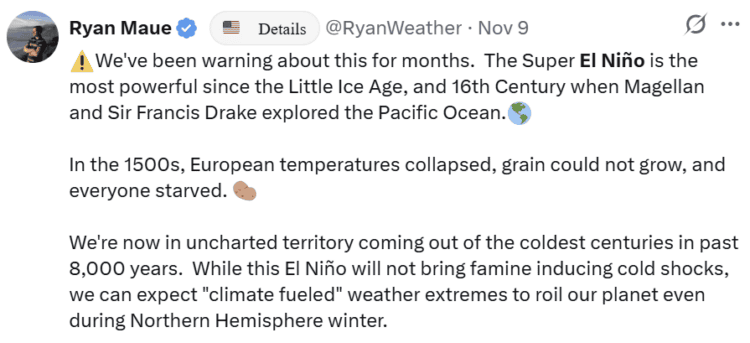
What El Niño Is, in Plain Words
El Niño is a natural pattern that happens every few years when the ocean along the equator in the central and eastern Pacific runs warmer than normal. Warm water means big rain clouds form in different places than they usually do, and that shift ripples outward until it nudges the jet stream. That’s the river of fast-moving air way up high that steers storms across the United States. During a strong El Niño, the jet stream tends to dip farther south and east, which usually means a stormier, wetter South and a milder North. Notice I said usually.
So what makes this El Niño different? It’s big, really big, and one reason is the huge patch of Pacific Ocean forecasters have been focusing on. It’s been running more than 2°C (about 4°F) warmer than normal in September, and parts of the eastern Pacific were more than 4°C (7°F) above normal. NOAA now gives better than an 83% chance that this stays a strong-to-very-strong El Niño through early 2027, and there’s a good chance history books will record it as one of the most powerful on record.
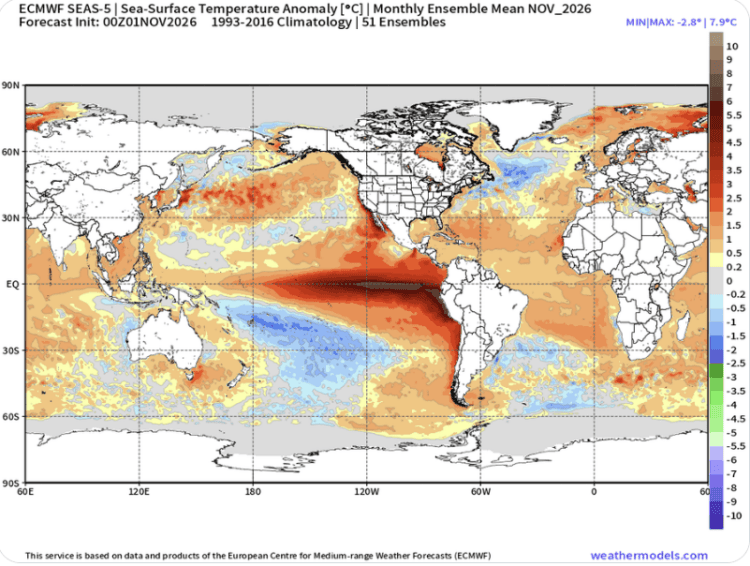
These maps and predictions are scary, but NOAA itself says that with an event this big, the chances of typical El Niño effects are larger, “though not guaranteed.” A seasonal outlook describes the average of a whole winter, not the weather on any single day. A winter that’s fairly mild can still deliver one crippling ice storm or a week of bitter cold, so the goal is to be prepared for your area’s potential worst day, not its average day.
The folks in Atlanta during that 2014 storm were prepared for a typical, mild winter, and nowhere near prepared for the storm they got.
What This Winter’s Outlook Means Where You Live
NOAA’s official winter outlook, issued October 15, 2026, is built around this El Niño. Their forecasters say that wetter weather in the Southeast is, “one of the most reliable signals” of El Niño. With that, the odds are for above-normal precipitation in nearly all of the far Southeast and northern Florida through the January to March season. The highest odds (remember “odds”!) are for a warmer-than-normal winter from the Pacific Northwest, across the northern Plains, the Great Lakes, and then into the Northeast.
| Region | Temperature tilt | Precipitation tilt | What to prep for |
|---|---|---|---|
| Great Lakes, Upper Midwest & interior Northeast | Leaning warmer, with some of the highest odds in the country | Drier in parts of the Great Lakes; wetter along the East Coast | Ice storms and cold snaps still possible; check pipes and heat backup |
| Ohio Valley & Mid-Atlantic | Leaning warmer | Equal chances in the Ohio Valley; wetter along the Mid-Atlantic coast | Rain near freezing can mean ice; coastal storms |
| Southeast, Gulf Coast & Florida | Near normal for much of the Southeast; warmer in south Florida | Wetter, the strongest wet signal in the country | Heavy rain, flooding, severe storms, and outages |
| Texas, Central & Southern Plains | Equal chances in the south | Wetter | Flash flooding and winter storms that still knock out power |
| California & the Southwest | Leaning warmer in California; equal chances in the Southwest | Wetter, especially Southern California | Flooding, mudslides, and debris flows near hillsides and burn scars |
| Pacific Northwest & Northern Rockies | Leaning warmer, highest odds near the coast | Drier in the northern Rockies and High Plains | Low snowpack, drought developing or worsening, and an earlier wildfire season [verify] |
| Alaska & Hawaii | Warmer in much of Alaska; equal chances in Hawaii | Drier in much of mainland Alaska and Hawaii | Rain on snow and icy roads in Alaska; water conservation in Hawaii |
Getting Ready For A Flood Season
For a big part of the country, from Southern California all the way to the Carolinas, the biggest El Niño risk is simply too much water. This can range from desert flash floods, mudslides, and massively overflowing lakes and rivers. This is what caught my town completely off guard when Hurricane Harvey happened in 2019 — an overfilled lake, a dam opening in the middle of the night, and then thousands of homes and businesses flooded.
Check Your Flood Insurance Now, Not in January
When we moved from Phoenix to southeast Texas, our real estate agent emphasized the importance of flood insurance. It rarely rains in Phoenix, so buying insurance in case of a flood was news to us! The most important thing to know is that most homeowners and renters policies don’t cover flood damage, and a separate flood policy through the National Flood Insurance Program usually has a 30-day waiting period before it takes effect.
That means the time to buy it is now, not when a major storm is in the forecast. Call your insurance agent to ask one question, “Am I covered if water comes into my house from outside?”
When you look over your coverage, it helps to work through the questions in my annual insurance review at the same time, and to take a slow video walk through every room of your house so you have a record of what you own.
Get Water Moving Away From the House
Clean gutters and downspouts before the rains begin, and make sure the downspouts empty several feet away from your foundation instead of right beside it. If you have a sump pump, pour a bucket of water into the pit to make sure it switches on, and think about a battery backup like the Wayne ESP25n, since a pump doesn’t do you any good when the storm knocks out your power.
If there are storm drains along your street, get in the habit of sweeping away the debris before a storm, and then bagging it up so it’s not washed into the drains again with the rain. Houses at the end of our street flooded because their storm drains were clogged, and the water had nowhere else to go.
If your house sits low, keep a 6-pack of Quick Dam flood bags on a shelf. They stay compact until they get wet, and you won’t be filling sandbags in the rain.
Move Valuables Up and Know Your Way Out
Walk through your basement, garage, and ground floor and lift anything you can’t replace onto shelves or upstairs, including photo albums, important papers, and family keepsakes and valuables.
A SentrySafe fire- and water-resistant bag is a simple way to keep important papers together, and it’s easy to grab if you have to leave in a hurry.
Learn which local roads flood first and how you would leave if you needed to, and if you live below a hillside or near a recent burn scar in California, take mudslide warnings seriously, and leave early. My guide to organizing your evacuation in five simple steps will help you put a plan on paper.
Never Drive Through Floodwater
When the water is rising, and you’re not sure your home is safe anymore, it’ll be tempting to evacuate. That’s the right decision as long as you can get out and the streets aren’t flooded. Just 12 inches of moving water can carry away most cars, and 6 inches can knock an adult off their feet. If you see water across the road, turn around, even if the car ahead of you made it through, and teach your teen drivers to do the same.
You can’t judge the depth or the speed of the water accurately just by looking, especially at night. Floodwater also hides washed-out road surfaces, potholes, and debris from the storm, so the danger comes from both the rapid flow of water and whatever you can’t see that lies beneath it.
Ice Storms and Power Outages in the South
El Niño doesn’t only mean more rain in the South. When cold, winter air settles in near the ground and all that extra moisture falls, the result can be freezing rain. That frozen rain coats trees, power lines, and roads in a heavy shell of ice, and Winter Storm Fern in January, 2026, left over two million people without power, some for more than two weeks.
With El Niño, NOAA’s outlook actually shows near-normal temperatures for most of the Southeast this winter, but that still includes freezing temperatures at night. And that, of course, is playing the odds!
- Trim trees before the ice comes. Ice can multiply the weight of a branch hanging over your roof or driveway. Call your utility company for anything near the power lines instead of doing it yourself.
- Pick a warm room now. Choose one interior room with few windows and plan on doing most of your living there through a winter power outage. Collect blankets, sleeping bags, hats, and wool socks there, along with snacks and water. Your goal is to create a warm microclimate inside your home. My guide to staying warm without electricity walks through the details.
- Protect your pipes. Now’s the time to find out where your most vulnerable pipes are. In our Texas home, we have plumbing in the attic, along exterior walls, and crawl spaces because homes here were never built for an extended hard freeze. Wrap exposed pipes, cover outdoor faucets, and know where your main water shutoff is. If a pipe breaks and water begins flooding your home, your first step is to shut off that water source.
- Insulate your floors. A lot of body heat is lost due to the cold, conducted through your floors. Put down layers of cardboard, blankets, towels, and always wear a combination of heavy wool socks and shoes or slippers.
- Plan safe heat and safe light. Put a battery-backed carbon monoxide alarm on every sleeping level, never run a generator, grill, or camp stove indoors or in the garage, and use flashlights or LED lanterns instead of candles.
- Think about medical needs. If anyone in your home relies on oxygen, a CPAP, or medication that must stay cold, write down a backup plan, and refill prescriptions before a storm is in the forecast. If anyone in your house relies on a CPAP or other medical device, a Jackery Explorer 300 can cover a night or so, though you’ll want to check your machine’s wattage first.
For a full walk-through of supplies and planning, see my guide to preparing for a power outage.
Nor’easters on the East Coast
If you live along the East Coast, don’t let the word “mild” lull you into putting the snow shovel back in a far corner of the garage. El Niño winters tend to push extra moisture up the Eastern Seaboard, and NOAA’s outlook suggests it’ll be a lot wetter along the coast this year. In the past, strong El Niño winters have stirred up more of those classic nor’easters, the ones that bring heavy rain or snow, howling wind, and flooding along the coasts.
New Yorkers still talk about the last “super” El Niño. In January 2016, a blizzard buried Central Park under more than two feet of snow, in a winter that was supposed to be on the mild side, according to weather forecasters.
A winter can “lean” mild overall, but it only takes one powerful nor’easter to dump a foot of heavy, wet snow on your roof or push seawater into low-lying streets. Mild on average doesn’t mean mild on a specific day.
If you live near the coast, your assignment is to learn your evacuation zone and know where you would go. Keep sandbags or a flood barrier on hand if your home sits low, and move cars to higher ground when a coastal flood warning is issued. And check into buying flood insurance.
My guide to severe weather preparedness covers the basics for all types of storms.
The Milder North Still Needs a Plan
If you live in the northern part of the country, the Great Lakes, or the Ohio Valley, the outlook may sound like good news. You aren’t a primary target of El Niño’s extreme weather. A milder winter can mean lower heating bills for some northern households, though that depends on fuel prices and on how the winter actually plays out. Still, it’s wise not to let your guard down.
Cold Snaps Can Still Happen
A warm seasonal average can trick you into thinking it’s a super-early spring, and then hide a week of dangerous cold. A single ice storm or blizzard is all it takes to cause trouble. If you would like a refresher, my posts on surviving severe winter weather and getting prepped for winter are good places to start. This winter, the National Weather Service may also use the label “Particularly Dangerous Situation” on its most serious blizzard and ice storm warnings, so if you see those words, act on them right away.
Drought and Wildfire in the Northwest and Northern Rockies
The official NOAA El Niño forecast predicts a drier winter in the northern Rockies and High Plains. That might result in a developing or worsening drought in areas such as northeastern Oregon and eastern Washington. The real danger lies in less mountain snowpack, which is the water supply many western towns depend on through the summer. It can also set the stage for an earlier fire season.
Think about defensible space around your home this spring, before fire season arrives, and keep a full winter kit in the car for mountain passes, because mild doesn’t mean safe when driving at higher elevations.
Your Home, Car, and Pantry Checklist
No matter where you live, here are a few essential steps to take to be as prepared as possible.
- Learn your flood risk and review your insurance policies. Find out whether or not you’re in a flood zone, if you need flood insurance, and review your policies to make sure you have enough coverage for things like structural damage, fencing, outbuildings, and the like.
- If you have a sump pump, test it. Consider a battery backup.
- Locate storm drains near you and have the right tool(s) to clean them before a storm arrives.
- Plan where you’ll set up a warm room, and when you see a winter storm approaching, assemble everything you’ll need to create that safe, warm space in case of a power outage.
- Install and test carbon monoxide detectors. This is so important if you might be using a generator, even one near your home. And never use a grill or camp stove inside your home.
- Have a plan to protect your pipes, including vulnerable pipes inside your home. Wrap exposed pipe, cover and drain outdoor faucets, and find your main water valve.
- Build or update your vehicle’s winter survival kit. Add wool blankets, hand and foot warmers, a snow shovel, and waterproof boots, in case you have to walk through snow and icy sludge.
- Check your emergency food supply, and make sure you have at least 7 days worth of foods that don’t require cooking. Double check your current supply of pet food, baby formula, and bottles of water (frozen pipes will leave you without faucet water).
- Keep your devices and power banks charged. They may become a literal lifeline in case of a major weather event. Have several smaller power banks for your phones and small devices, and a larger power station for things like keeping the fridge running. Anker, Goal Zero, and Jackery are brands I’ve used and found to be reliable.
- You’ll need a source of reliable information from official sources as well as a way to stay in touch with family and friends. A hand-crank NOAA radio like this FosPower one means you can still get weather alerts if the power and the cell network both go down.
Get My Free Winter Prep Checklist
If you want a paper-and-pencil plan for El Niño weather events, grab it here.
Frequently Asked Questions
El Niño is a natural weather pattern in which the ocean along the equator in the central and eastern Pacific runs warmer than normal. It shifts the jet stream and storm tracks, which changes the odds for winter weather across the United States.
In October 2026, NOAA’s Climate Prediction Center said a strong to very strong El Niño is likely through January to March 2027, with a high chance it becomes the strongest event on record since 1950.
It often means a milder winter in the northern part of the country, but not everywhere and not every week. Cold snaps, ice storms, and blizzards can still happen, so keep your winter plans in place.
NOAA’s outlook favors a wetter winter for the Southeast and Florida, the Gulf Coast, the central and southern Plains, California and the Southwest, and along the East Coast.
Usually not. Policies through the National Flood Insurance Program generally have a 30-day waiting period, so buy coverage well before the stormy season. Check the details with your agent.
Find out your flood risk and review your insurance, then make sure you have a safe way to stay warm and a carbon monoxide alarm on every sleeping level.
The Final Word
Learning about a strong El Niño isn’t a reason to worry, but instead, it’s a gift of time. You now know which way this winter is likely to lean while you still have weeks to get ready. Find your region and take notice of the two or three risks that could impact your family the most. Then prepare for them. Whether your winter brings floodwater, freezing rain, a nor’easter, or a dry spell, you’ll meet it calmly with a plan in hand. Prepare more, panic less.