
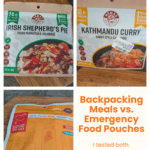
I tested seven backpacking meals from five brands using the same four criteria I apply to all emergency food. Is the meal prep quick and easy, is there plenty of real nutrition, and how does it taste? Every single one passed, which is more than I can say for most emergency food on the market. These aren’t marketed as survival meals, but they’re a big improvement over the ones that are, and here’s exactly what I found.
If you’ve read my Legacy Food Storage review, you already know I have four criteria I use when I evaluate emergency food meals:
- Is it practical to prepare in an actual emergency?
- Does the nutrition actually do something for you?
- Can it be made quickly?
- Does it taste good enough that people will eat it?
Legacy failed all four. So I started looking at what would pass, and backpacking meals kept coming up.
These are the pouched meals designed for hikers and backpackers, not especially for food storage. They’re lightweight, high-calorie, and built for people who need a real boost of energy after a hard day on the trail. I tested seven meals across five brands, and while none of them are perfect, every single one passed my four criteria, which puts them in a completely different category than most emergency food on the market.
Here’s what I found.
In This Article
The Backpacking Meals All Pass My Test
Practical in an emergency
The prep for each of these meals required only boiling water poured directly into the pouch. That’s the type of prep I expect from anything called an “emergency meal.”
No pot and extra cooking on a stovetop and minimal cleanup — just the pouch itself and maybe wash up a couple of forks.
In a real emergency, like a power outage, an evacuation, or a hurricane, that’s the type of simplicity that matters. You can boil water on a camp stove, a propane burner, or an electric kettle powered by a portable power station — my own favorite way to make these meals. If you’ve got any of those in your kit or home, you can make these meals.
Compare that to the Legacy Classic Chili, which required forty minutes of cook time and eight cups of water. That’s exactly what I don’t want to deal with in the middle of an actual emergency.
Nutrition
This is where backpacking meals outshine most of the emergency meals I’ve tasted. These meals are designed for people burning thousands of calories a day on a trail — rugged, outdoor activity. And, with that market in mind, they have to deliver significant amounts of protein, real fat, and real calories.
But also, for the non-rugged among us, emergency meals are meant to provide you with a hearty meal, loaded with calories and nutrition to see you through a crisis — which is why I’ve emphasized the importance of nutrition in these types of meals.
The backpacking meals I tested ranged from 270 to 610 calories per serving, with protein ranging from 17 to 23 grams per serving. Even the lowest-protein meal in my test (Good To-Go Pad Thai at 17g) beat out the Legacy Food’s Stroganoff’s with 10g. Most of these backpacking meals had sodium in the 330–470mg range, a fraction of the 1,160mg per serving in Legacy’s Classic Chili. Overall, the emergency meals I’ve tested have far more sodium.
You’ll also notice these meals contain more nutrient-dense ingredients like meat, veggies, and legumes. They don’t rely on pasta or rice as the primary filler with a little flavoring powder on top — a real disappointment with typical emergency meals.
Speed
The fastest prep method I tested was with an electric kettle. Since these meals only required less than two cups of water, it came to a boil in barely over a minute. Pour it directly into a pouch, seal it, and you’re done. Most of these needed 8-10 minutes in the pouch before serving.
For a bug-out situation or a stressful emergency where you need to eat fast and keep moving, it’s good to know you can have a hearty and nutritous meal in under 15 minutes.
Taste
This is where you have to remember that taste is personal, and I only tested one or two meals per brand. What I didn’t like, someone else might love. I’ll tell you exactly what I thought, but take my tasting notes apply to the specific meal, not the entire brand itself.
What I can say across the board, though, is that these meals are seasoned to actually taste like food. That sounds like a low bar, and it is because most emergency meals are simultaneously high in sodium and, yet, bland enough to need a shake or two from the salt shaker.
Some of the links in this post may contain affiliate links for your convenience. As an Amazon Associate, I may earn a small commission from qualifying purchases without any increase in price to you.
The Honest Trade-Offs
Before we go further, here’s what you need to know about the downside.
They’re expensive. Plan on $10 to $15 per pouch. Depending on the brand, a pouch will have one or two servings. If you’re used to emergency meal pricing where $50 buys a week of food for a family, this will feel like a gut punch. With today’s rising prices, though, they aren’t all that far off.
They’re not for bulk stockpiling. I don’t recommend buying 90 days’ worth of these. The cost doesn’t make sense, and you really don’t need to. More on that in a minute.
Serving sizes can be generous or a little stingy, depending on the brand. These are designed for one or two people, not a family of four. If you have a larger household, plan accordingly.
The good news on cost: unlike most emergency food companies that only sell in bulk buckets and no single meals available, every brand I tested sells individual meals. You can buy one, try it, and decide if you want more. That’s a major advantage over companies that ask you to spend $200 before you know if your family will eat the food.
7 Meals I Tested: Tasting Notes
Again, these are tasting notes from one person, me, who tested one or two meals per brand. They are not comprehensive brand reviews.
Nomad Nutrition: Irish Shepherd’s Pie
580 calories | 24g protein | 330mg sodium | 1 serving
This was a solid meal. Hearty, filling, and it actually tasted like shepherd’s pie with mashed potatoes, seasoned meat, vegetables, but all mixed together. The nutrition numbers are among the best in my test with 24g of protein and the lowest sodium of the group. If you like comfort food and want something that will actually keep you going, this is a strong choice.
My rating: 3/5 Good meal, nothing wrong with it, just not a standout.
Nomad Nutrition: Kathmandu Curry (vegetarian)
610 calories | 18g protein | 340mg sodium | 1 serving
The highest calorie meal I tested, and the ingredients were quality. I just didn’t love the flavor on this one, even though I generally like curry. Curry is one of those things you either like or you don’t. If you like a bold, spiced vegetarian meal, this might be exactly what you’re looking for. The protein is a little low for a vegetarian meal at 18g, but the calorie count makes up for it. Also, pricey at $13.99 for a meal that doesn’t contain any meat.
My rating: 3/5 Not my thing, but I can see why others would like it.
460 calories | 17g protein | 340mg sodium | 1 serving
Good flavor. My husband didn’t like it because of the nuts, which is worth mentioning if anyone in your household has a nut allergy. The protein is the lowest in the test at 17g, and it didn’t contain any discernible chunks of meat. Freeze-dried chicken would have been a great addition. That said, it was tasty and filling but not a favorite.
My rating: 3.5/5 Good, filling meal.
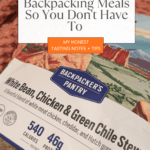
Backpacker’s Pantry: White Bean, Chicken & Green Chile Stew
270 calories | 23g protein | 455mg sodium | per serving (2 servings per pouch)
Of the meals I tested, the protein in this one really stood out in terms of quality-to-serving ratio. With 23g per serving with real chicken and good flavor with a mild green chile kick, My first reaction was, “This is hearty!” With the beans and lower calorie count per serving, it’s still filling, and the protein goes a long way towards satiety. Note that this is a two-serving pouch, so the full meal is 540 calories and 46g of protein, plenty for two people or a very hungry one.
My rating: 4/5 Would buy this one again
400 calories | 20g protein | 470mg sodium | per serving (2 servings per pouch)
This was my favorite of the entire test. Plenty of beef, actual mushrooms, and a rich sauce with a sour cream flavor you could taste. This one tasted like stroganoff. I mention this because I also tested the Legacy Food Storage Stroganoff, where I ate three pieces of pasta and stopped because it was so bad. These are not comparable products. If you want to understand the difference between a backpacking meal and a budget emergency meal, put these two side by side.
My rating: 5/5 The clear winner and recommended.
360 calories | 20g protein | 710mg sodium | per pouch (2 servings)
⚠️ Note on labeling: Beyond Outdoors products on a couple of “survival” websites list calories and protein per pouch on the websites, not per serving. That 20g of protein is for two servings, just 10g each. Read the label carefully before you make purchasing decisions based on the marketing copy that reads, “High Protein Per Pouch (41g), Hearty 710-Calorie Meals.” That’s only if one person eats the entire pouch, labeled, “2 servings.”
As for the meal itself: so-so. Chili mac is hard to mess up, and my homemade version could win a gold medal, but this one was short on flavor. The sodium is oddly high compared to the other brands and it needed additional salt for seasoning. Not a meal I’d repurchase.
My rating: 2.5/5 Filling, if you eat the whole pouch. Plan on adding more salt.
Beyond Outdoors: Chicken Mac & Cheese
360 calories | 23g protein | 460mg sodium | per pouch (2 servings)
Same labeling caveat as above — pouch contains two servings. This meal was better than the Chili Mac, and actually quite tasty. More flavor, plenty of chicken, and the mac and cheese base works well. Still not at the level of Peak Refuel or Backpacker’s Pantry, but a decent option if you find it on sale.
My rating: 3/5 Decent meal with a good amount of protein per serving.
How To Use These In Your Emergency Prep
Now that you know what these meals are and what they cost, here’s the practical question: where do they fit?
In your bug-out bag or evacuation kit
This is where backpacking meals earn their keep. If you ever have to leave your home in a hurry due to a wildfire, a flood, or a mandatory evacuation, you need food that’s lightweight, calorie-dense, and fast to prepare. Backpacking meals check every box.
Pack a small backpacking stove and a couple of fuel canisters alongside a few of these pouches and some matches. You’ve got filling and highly nutritious meals that can be prepared anywhere, in under fifteen minutes and no cleanup.
If you frequently have a very long commute or are planning a road trip, these are the meals I’d stock up on and be ready for cooking up a quick meal on the road. That’s not something you can say about most emergency food meals.
For one- and two-person households
Most emergency food is sized and priced for families of four. If you live alone or with a partner, you’ve probably noticed that the math never quite works in your favor. You’re buying more than you need, spending more than you want to, needing to store a larger amount of food than you might want or need, and eating the same giant rotation of meals.
Backpacking meals are a natural fit for smaller households. Buy one meal per day for 14 to 21 days, pair them with inexpensive canned goods and other shelf-stable foods, and very quickly, you’ll have a solid three-weeks of food for emergencies. There’s a huge variety in the world of backpacking meals, so you’ll never get bored or deal with food fatigue.
To supplement what you already have
If you already have emergency meals stockpiled, you don’t have to throw them out. Add a handful of backpacking meals for variety, for better nutrition on the harder days, and for the meals that are ready to eat more quickly.
With some of the meals, stews and chilis are good examples, you could add some cooked rice, another can of beans, or a cup of cooked macaroni to have more servings and calories. Here are some tips for stretching meals, many can apply to pouch meals.
What if you haven’t tested what you already have? That’s the place to start. Pull one pouch, prepare it exactly as directed, and eat it. You’ll learn more from that single test than from any review online because when it comes to food and flavor, everything is subjective. Download my emergency meal tip sheet (below) to help you evaluate and improve whatever you’ve already got on hand.
The bottom line
Backpacking meals aren’t cheap, and they’re not meant to be your entire emergency food supply. When I first saw the prices, I gasped. But these meals pass every test that most emergency meals fail, and they do it with better ingredients, more protein, better nutrition overall, and much better taste.
My best recommendation: buy a few and test them yourself. There’s so much variety out there that you can try both familiar and new flavors and dishes to find the ones your family will eat. Then use them where they make the most sense: in your but out bag, packed in your car’s emergency kit, in your short-term food storage, or as the meals you actually look forward to when the power’s out.
The Peak Refuel Beef Stroganoff is a good place to start.
Already have emergency meals at home? My Legacy Food Storage review walks through exactly how most of them fall short and what to look for instead.
Some of these brands I’ve honestly never heard of but will trying them. Do they have the pretty standard 20 – 30 year shelf life? I’ve always been a Mountain House fan.
Yeah, there are still a few dozen brands I haven’t tried! I had no idea. These were packaged in thick, heavy-duty mylar bags with an oxygen absorber, so I would expect a long/longer shelf life.
Try going to Rural King or any place that sells other types of backpacking supplies, they also have theses meals. But buying online might be less expensive, but if you only plan on getting a few to try them out it might be okay. I know I have seen backpacking meals at Rural King.
There isn’t a Rural King near me, but I know REI stores carry these. As much as I dislike giving business to Amazon, they probably have the biggest selection.