

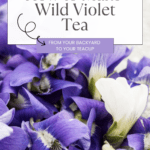
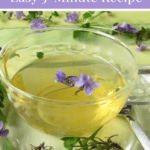
Wild violets may seem like weeds, but they are actually edible, and have been used for centuries for their health benefits. Here’s the simple 5-minute recipe for brewing them into a delicate tasting floral tea, plus tips on foraging, straining, and how to change the color of the tea magically!
If you’ve ever looked down at your lawn in early spring and noticed clusters of small purple flowers peeping up through the grass, there’s a good chance you’ve been walking past something useful. Wild violets are one of those plants that most people treat as a weed until they find out what they’ve been mowing over.
The flowers and leaves are edible, historically medicinal, and they make a very pretty tea. The tea is something you’d want to sip on and enjoy on a slow spring morning.
This article updated with most recent information and additional details, May, 2026.

Some of the links in this post may contain affiliate links for your convenience. As an Amazon Associate, I may earn a small commission from qualifying purchases without any increase in price to you.
Brewing wild violet tea is just the beginning! Wild violets are just one small part of natural medicine. Violet leaves and flowers have been used for centuries to soothe coughs, reduce inflammation, and even improve skin health. Natural medicines were one of the go-tos during the Great Depression, too. But we’re getting ahead of ourselves. Let’s start with tea!
Table of contents
What Are Wild Violets?
Wild violets (Viola sororia and related species) are low-growing perennials that bloom in early spring, usually March through May depending on your region. They grow across most of the eastern and central United States, from Maine to Florida, and as far west as Texas and the Great Plains. If you’re in the South, look for them in late winter to early spring; in northern states, they typically bloom April through May.
They tend to show up anywhere the soil is slightly moist and shaded, like lawns and along the edges of a wooded area. The flowers are purple or blue-violet and sometimes even white. They’ll have five petals and a slightly heart-shaped leaf. And, they’re small, which is one reason they’re easy to overlook. They’ll only grow to be a few inches tall.
A Little History Worth Knowing
Wild violets have been harvest, dried, and steeped to make a tea for decades. Before vitamin C tablets existed, people had to get their nutrients from food and plants, and wild violets happen to be exceptionally high in vitamin C. Doctors in the 1800s and early 1900s reportedly recommended eating violet leaves for exactly that reason.
During the Great Depression, foraging wasn’t a hobby. As food was sometimes scarce and families needed to find ways to stay healthy, foraging became a family activity. Violet leaves was picked and added to salads, soups, and teas. People knew and could recognize edible and medicinal plants in a way few of us do nowadays.
Medicinal Benefits of Wild Violet Tea
Besides being used to supplement Vitamin C, wild violets have been used in traditional herbal medicine for centuries.
Anti-inflammatory properties. The leaves and flowers both contain compounds that may help reduce inflammation, which is why various violet remedies have been used for sore throats, coughs, and respiratory ailments.
High vitamin C content. As mentioned above, violet leaves are a legitimate source of vitamin C, and useful historically when fresh produce wasn’t always available.
Antioxidants. Violets contain rutin and other flavonoids that act as antioxidants in the body.
Topical use. Violet-infused preparations for liniments and tinctures have been used over the years for skin irritations and minor wounds, though tea is the simplest way to use them.
This information is for educational purposes only and is not intended to diagnose, treat, or prescribe for any condition. Talk to your own doctor before using any herb medicinally.
Harvesting and Drying Your Own
If you have violets growing in an area you know to be pesticide-free, you can harvest them yourself. Pick flowers and leaves in the morning after the dew has dried. Spread them in a single layer on a screen or clean towel and let them air dry for several days, or use a dehydrator on its lowest setting (around 95°F). Once completely dry, store in an airtight container in a cool, dark place for up to a year. Be sure to label the jar, since dried plant parts sometimes look a lot alike!
If you’re not ready to forage your own, dried violet leaves and flowers are available online from reputable herb suppliers like Monterey Bay Herb Company, and of course, you can buy wild violet seeds and plant them in areas that are shady, moist, and unlikely to be bothered by lawn mowers.
Wild Violet Tea Recipe
This recipe couldn’t be simpler. The only real trick is not letting it steep too long. Once the steeping gets past five minutes, it starts to get bitter.
Ingredients
- 2 tsp dried violet leaves
- 1 tsp dried violet flowers
Instructions
Step 1
Add 6- 8 ounces boiling water to dried leaves and flowers.
Step 2
Steep for five minutes. Set a timer, and don’t wander off.
Step 3
Strain out the flowers and leaves.
Step 4
Drink as is or sweeten to taste. I like honey in my teas and always have some on hand. Note: Honey will alter the color.
Fresh flower option: If violets are blooming in your yard right now, you can use two teaspoons of fresh flowers in place of the dried mix. The flavor will be a bit more delicate.
On sweeteners: Honey goes naturally with this tea and adds its own mild health benefits. Be aware it will darken the color of the tea. Raw local honey is always my first choice, since I then get the double benefit of the sweetener along with some protection from local allergies.
The Color-Change Trick
This is the part that makes wild violet tea fun — more than just plant parts steeped in hot water. If you have kids around, they’ll love it.
When violet tea is just brewed, it has a soft blue-purple color. When you add a squeeze of lemon, it turns pinks. Add more and it begins to turn red. This may look like magic, but it’s just chemistry. Wild violet contains a natural pH indicator called anthocyanin, the same substance that makes red cabbage change colors in science experiments.
Before modern litmus paper existed, violet tea was actually used as a rudimentary pH indicator. So if you want to get your kids intrigued with science , this is your science lesson for the day. Let the kids experiment with lemon juice, a pinch of baking soda, and see what happens.
FAQ
Absolutely not. African violets, which are common houseplants, are not suitable for tea. Stick to wild violets and make sure you can confidently identify them using a field guide or online resource.
It can vary by person but most describe violet tea as having a subtle, floral flavor. Some describe it as earthy with hints of sweet or grassy.
Yes. The flowers alone will give you a more delicate, sweeter tea. The leaves contribute more of the “green” flavor and are where most of the vitamin C content is concentrated.
Related Wild Violet and Foraging Content
- How to Enjoy Wild Violets for Food and Medicine: A Simple Guide to an Edible Weed
- How to Forage: Learn the Basics of How to Feed Yourself with Wild Foods
- A Brief Guide to Edible Weeds
- Stay Healthy Using These Great Depression Remedies
- Herbal Teas for Extra Nutrition
Final Thoughts
So there you have it! With a simple brewing process and a little exploration, you’ve got a delightful cup of violet tea. True, the kids will probably have more fun playing around with the color, but regardless, it’s a fun way to connect with nature, enjoy a unique flavor, and create a lasting memory together. Let me know in the comments if you enjoy this wild violet tea recipe!
I’ve also read that back in the “early days” (1800’s and early 1900″s) doctors recommended eating violet leaves because they are very high in Vitamin C. Back then there were no vitamin tablets to take. Walking with my dogs, we live on 80 acres, I often “forage” on plants along the way such as clovers, violets, wild onions & garlic. I also make a pine needle tea which also is very high in Vit. C. Now I am discovering other plants such as Mullein, Cleavers, Chick weed. I never thought of making tea from violets so I enjoyed this article.
That’s great info about wild violets! Thanks!