

When I was a kid, I’d raid my Nana’s stack of Reader’s Digest magazines looking for one thing — the survival stories. “Alone. Injured. Almost Dead.” “438 Days at Sea.” I couldn’t get enough! I didn’t know it then, but those stories were teaching me something important about how real people behave when everything falls apart.
What I didn’t expect was that years later, I’d have my own stories to tell: a hurricane that turned my town’s familiar streets into rivers, eleven days without power in the Texas heat, a daughter alone in a snowstorm, and a pandemic that looked nothing like the disaster any of us had been preparing for. Those experiences changed how I think about preparedness more than any manual ever could.

This article updated with fresh examples and tips, February 2026.
In this article
- Why Survival Stories Teach What No Manual Can
- Hurricane Harvey: When the Disaster Is All Around You
- Hurricane Beryl: 11 Days Without Power
- My Daughter’s Snowstorm: Preparing Young Adults Who Live Alone
- COVID and the Lockdown — The Disaster That Didn’t Look Like We Expected
- What Real Survival Stories Teach Us That Nothing Else Can
- Real Survival Stories from This Community
- Final Thoughts on the Importance of Personal Survival Stories
- Frequently Asked Questions
Some of the links in this post may contain affiliate links for your convenience. As an Amazon Associate, I may earn a small commission from qualifying purchases without any increase in price to you.
Why Survival Stories Teach What No Manual Can
Survival manuals are always in demand because they help make preparedness seem simple and doable. Still, there’s a big difference between knowing the steps and actually feeling what it’s like when the water rises too quickly, the power stays out for days, or your college-age daughter is stuck alone in a snowstorm. No checklist can prepare you for the moment you realize things are worse than you thought, but reading about someone else’s real experience just might.
Survival stories offer something that how-to guides can’t. They let you step into a real person’s experience under pressure. You feel the urgency of making decisions without all the facts, in the dark, with others counting on you. You see what worked, what didn’t, and notice the things no one thought to prepare for—until now.
The stories I’m about to share are from my own life. They aren’t about dramatic rescues or surviving alone in the wild. Instead, they’re the kinds of emergencies that happen to regular people: a hurricane, a long power outage, a pandemic, or a young woman alone in a winter storm. Each one taught me something I couldn’t have learned any other way. If you read them with an open mind, they might teach you something too.
Hurricane Harvey: When the Disaster Is All Around You
I had been writing about preparedness for years before Hurricane Harvey hit in August 2017. I thought I was ready. We lived far enough from the river that flooding felt like someone else’s problem. We had emergency lighting, battery-powered fans, a gas stove that would work without power, and emergency kits already packed. My kids, 16 and 18 at the time, knew exactly where their kits were.
But I wasn’t ready for how quickly everything changed.
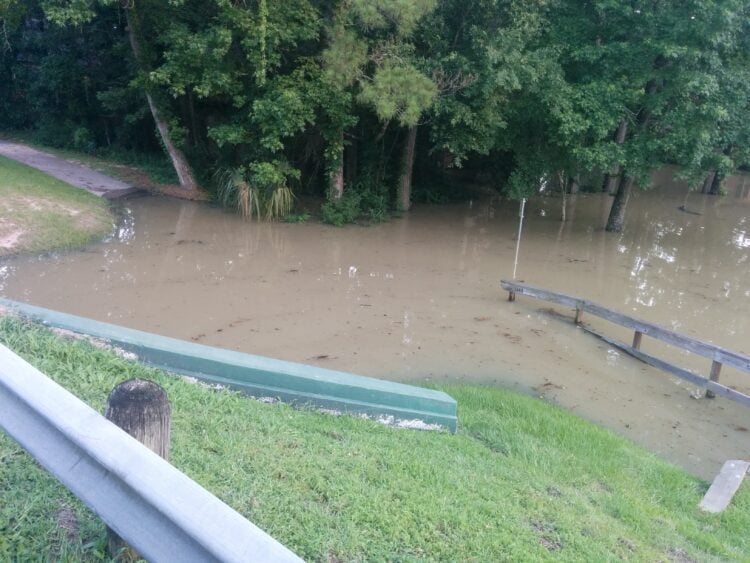
I turned on the local news and heard an announcer say something I’ll never forget: “If you live in this neighborhood, get on your roof and start waving a white t-shirt. The boat rescues will find you.” That’s when I realized just how serious things were. I told the kids to grab their kits and be ready to leave if the water got any closer. We checked an elevation app to see exactly how much margin we had. At just 12 feet, not much!
What We Expected vs. What Actually Happened
A lot of people don’t realize that what made Harvey so devastating wasn’t only the rain. In the middle of the night, the Conroe Dam was opened upstream without warning anyone living nearby. That sudden rush of water made an already terrible disaster even worse. This detail has stuck with me, because it shows that even after the rain ends, you might still be at risk. Decisions made by people far away can end up flooding your street while you’re asleep.
We were lucky. The water stopped short of our home, and our power was out for just one day. Thousands of other homes and businesses weren’t so lucky.
One police officer who was out trying to help people that night, drove into a flooded underpass in the darkness and drowned. He knew these streets, he was trained for emergencies, he was out there trying to save others, but he died not realizing those familiar streets were now six feet under water. If that doesn’t illustrate how quickly a familiar place becomes unrecognizable in a flood, I don’t know what does.
The Surprise That Changed How I Think About Community
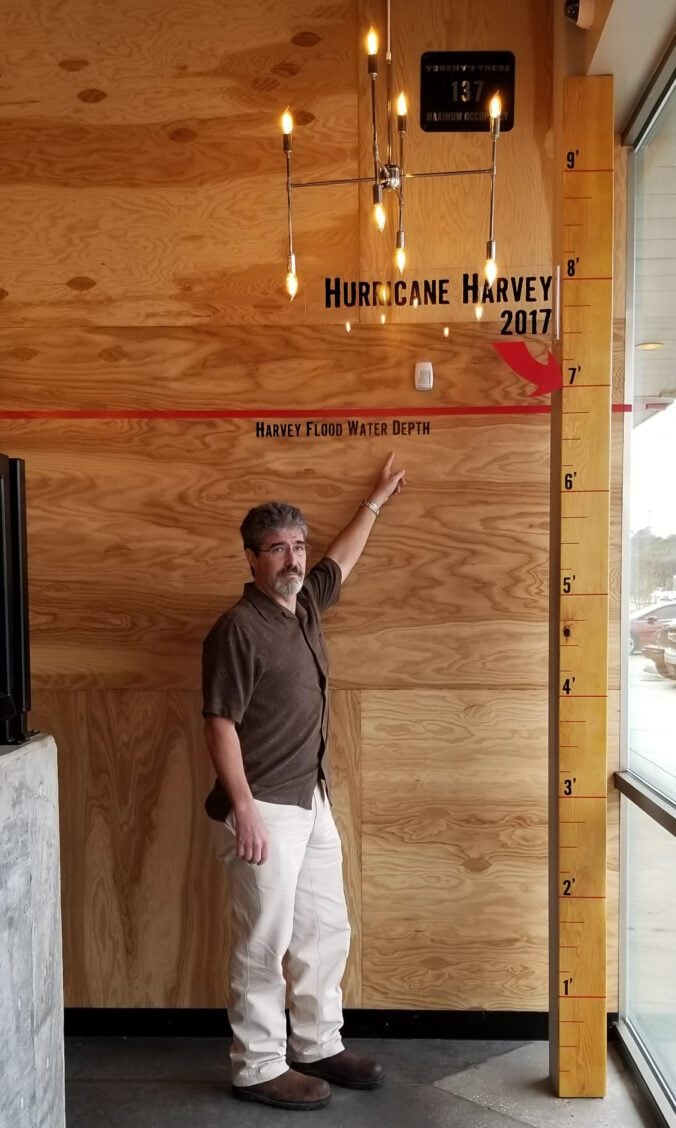
The next morning we got to work. We bought and delivered pizzas. We made sandwiches, loaded up bags of ice and bottled water, and helped local churches put together hygiene kits. I learned how to use the Zello app, in the middle of the disaster, not before it, and used it to help coordinate cleanup crews and meal deliveries. Our favorite taco restaurant, Torchy’s, has a memorial to the flooding to this day, including a nine-foot measuring marker showing exactly how high the water got. Every time I walk in, I think about those days.
What surprised me most wasn’t the destruction. It was the response. Restaurants gave away free food. HEB, cell phone companies, corporations of all kinds set up charging stations and supply drops. Community Facebook groups and neighborhood forums were flooded, if you’ll forgive the word, not just with requests for help but with people desperate to give it. The fire stations had to turn away food donations because there was simply too much. In the middle of one of the worst disasters our city had ever seen, people were remarkable.
What Harvey Taught Me About Preparedness
I had written about preparedness for years before Harvey. I thought I understood it. What Harvey taught me is that these situations are completely fluid. We went from “we’re far enough from the river, this couldn’t happen here” to “do we need to find some white t-shirts?” faster than you think possible. The most important thing isn’t having the perfect kit. It’s being ready to act when everything you assumed turns out to be wrong and trusting your judgement.
Hurricane Beryl: 11 Days Without Power
What the Generator Solved (and What It Didn’t)
Hurricane Beryl hit in 2024, and this time it wasn’t the water we had to worry about. It was the wind. Hundreds of mature trees came down in our neighborhood, crushing roofs, blocking roads, and taking out power lines buried so deep in the forest that repair crews could barely reach them. We lost five trees ourselves. Fortunately, none of them hit our home or cars. Not everyone was that lucky. The next day, we drove past beautiful homes with enormous trees laid across them, making them completely unlivable. Chainsaws ran day and night for weeks.
We were in better shape than most. My husband and I have a Kohler whole-house generator, properly installed, properly located. My husband is a master electrician licensed by generator companies, so placement wasn’t guesswork. He knew the rules: away from windows, weep holes, and vents, and he followed all of them. We loaned our portable generator and a power station to neighbors who had nothing, and settled in to wait out the outage.
Then, in the middle of the third night, I woke up with an odd headache.
I knew immediately when the carbon monoxide alarm went off what it was. What I didn’t know was that the unusually heavy, humid air from the storm had caused the generator fumes to behave differently than normal. Instead of dispersing away from the house as they should have, they lingered in the side yard and drifted into an upstairs vent. We immediately opened all the doors and windows, placed fans to blow the tainted air outside, and then sat on our patio for an hour or so until the detectors gave us the all-clear.
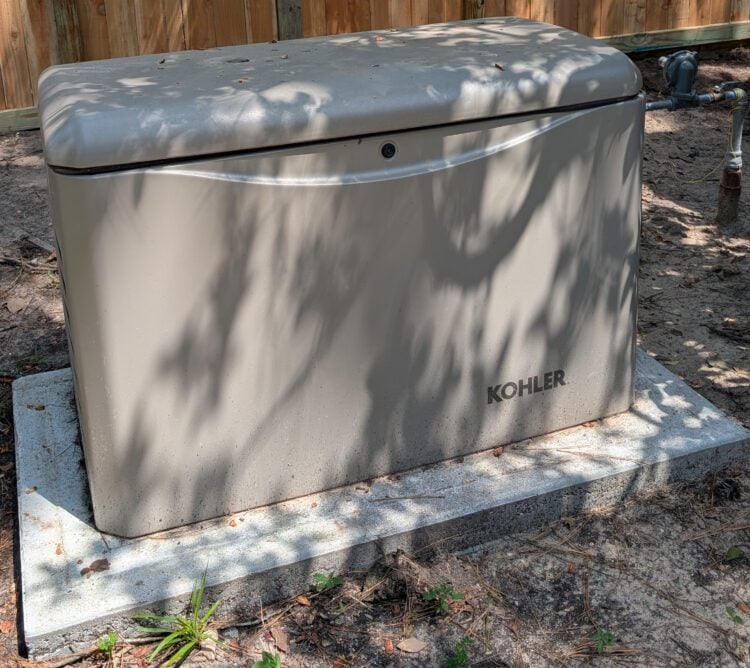
We learned later that emergency rooms across the area were seeing patients from the exact same thing — not just people running portable generators in garages, but people with properly installed home generators, too. If you have a generator, please have working carbon monoxide detectors on every floor. Ours saved us.
What Desperation Looks Like Up Close
By day six, the outage had settled into a different kind of hard. The acute emergency feeling had passed, but the power still wasn’t back, and the reality of an indefinite wait was wearing on people. We live in a heavily forested area and downed lines with no road access made repairs agonizingly slow. We kept checking the power company app, watching the progress inch toward our street.
Around us, we saw what a long outage does to people. One woman was driving around in her car just to run the air conditioning and keep her kids cool. Another was worried about her elderly dog suffering in the heat. At Lowe’s, people stood around an empty propane display, hoping for a shipment that hadn’t arrived. Our friend Yvonne needed her generator to run her oxygen tanks. Her generator had been damaged in the storm and knocked off its foundation. My husband made several trips to her house to troubleshoot it and get it running again. Yvonne’s generator was ultimately covered by her insurance. Her fence was not. And two homes in our neighborhood are only now, months later, beginning major repairs because of prolonged insurance battles.
What I’d Do Differently
That’s the preparedness lesson Beryl taught me that Harvey hadn’t: check your insurance before the storm, not after. Know exactly what’s covered, what isn’t, and what documentation you’ll need. And if you have a generator, even a good one, even a properly installed one, make sure your carbon monoxide detectors are working. My husband has since moved our generator even further from the house. Sometimes doing everything right isn’t quite enough, and the only thing standing between you and a very bad outcome is an alarm going off in the middle of the night.
It also taught me there’s a big difference between a power outage that lasts a couple of days and one that lasts a week or two. A long-term power outage plan is different than just having some canned food and a generator.
You never know how well prepared you are until you’re in the middle of an emergency.
My Daughter’s Snowstorm: Preparing Young Adults Who Live Alone
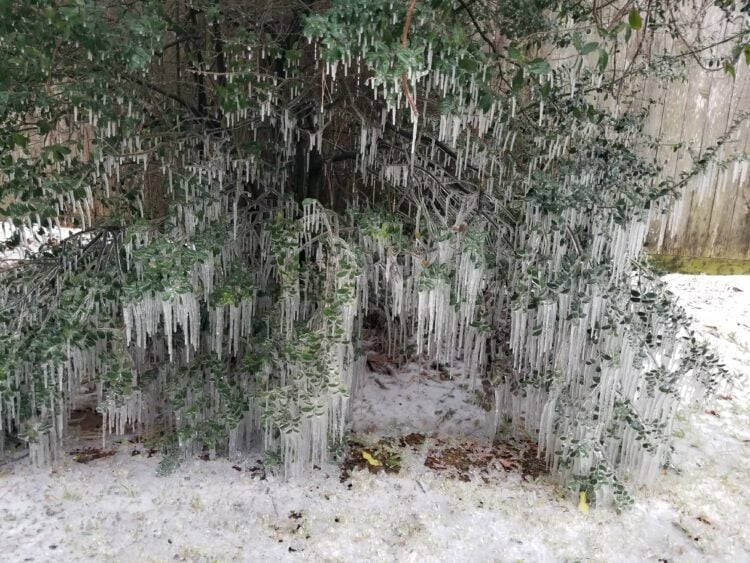
In February of 2021, Texas experienced the biggest snowstorm since 1989, known as Winter Storm Uri. The entire state was affected by the freezing temps and record-levels of snowfall. Down in Houston, my husband and I hunkered down with our heating pads, blankets, and two dogs to wait out the worst of the weather. My daughter, however, was over 150 miles from home in the north of Texas where she was attending college…and she lived alone.
When the Institution Fails You
When disaster strikes, all of us are tempted to look around us for who can offer help–first responders, the government, or privately-run disaster-response groups. For my daughter, the organization that she and her fellow students all were looking to for help was the university itself. All those young adults had been caught completely off-guard by the storm, unless they or their parents had been keeping tabs on the weather, and certainly none of them really grasped how bad the cold was going to be or how long it would last.
My daughter was one of the few lucky students who received advance warning from a friend that the university would be shutting off the water to all apartments and dorms to prevent frozen pipes, and was able to fill her bathtub with enough water to get by for a few days. Since the university did not issue any kind of announcement before doing this, however, most kids were startled to realize their faucets, toilets, and showers were suddenly no longer working at all.
After the fact, the university announced that water bottles would be handed out in the lobbies of dorms. Grateful, my daughter quickly went down to, hopefully, get a decent amount of drinking water to hold her over for a day or two, but was shocked when a well-meaning university employee put a single sixteen-ounce bottle of Ozarka into her hand, and then cheerfully waved her away as though a huge, benevolent favor had been done on behalf of the university.
While this one bottle of water was of little help, those students who had received warning to fill their bathtubs were not able to share resources with one another due to many COVID restrictions still in place. Students were not allowed to enter any dorm rooms or apartments that they did not actually live in, so sharing food and water wasn’t allowed.
If the cold had only lasted for a day or two (as snow usually does in a warm state like Texas), then shutting off the water and enforcing COVID social-distancing policies would not have had any significantly negative impact. However, the snow and ice stuck around for five long days, with cold conditions and risky road conditions lasting several days beyond that.
My daughter recalls that the water was kept off for about a week, and being able to finally take a shower after more than five days was actually a very emotional experience. While the university definitely strove to help students succeed academically, it unwittingly made a historic snow storm much worse for hundreds of unprepared college kids.
What She Did Right
I was immensely proud of my daughter when she told me what she was doing to keep herself clean, safe, and sane while she was stranded at her college apartment. Her bathtub full of water proved to be a lifeline, allowing her to flush her toilet by slowly pouring some of it into the toilet tank to flush. It also allowed her to use a washcloth and some warm water to keep herself relatively clean, and she boiled some of it so she could wash the few dishes she used during the week. Since there was very little warning before the storm hit, there was no opportunity for a grocery run before getting stuck in the dorms, so she got pretty creative with eating what she had with as few dishes and as little water as possible.
Our family has had some amazing travels over the years, including to some pretty chilly climates like Iceland and the UK. While many people who live in warmer climates don’t know how to dress or layer for the extreme cold, my daughter had her thermal layers, wool socks, water-proof boots, and Columbia winter jacket ready to go. Even though we Texans don’t get to wear winter gear that often, having those clothes available made life much easier during that difficult week.
Correct clothing meant my daughter could get outside once the storm had passed and explore the winter wonderland, make a short trek to talk to a friend, or just go on a short walk for some exercise in relative warmth and comfort. The evening before the freeze, I called her and told her to leave her cabinet doors open to keep the pipes in her apartment from freezing, and made sure she took stock of her emergency backpack and its supplies so she would be aware of what she had if things got bad. Of course, even though we knew it was about to get crazy cold, we had no idea that it would be record-breaking!
Being cooped up in one place for a week is something that would drive even the most introverted a little bit crazy. My daughter is definitely introverted, but she knew that if she did nothing and talked to nobody for an entire week, things would become exponentially more challenging on an emotional and mental level. Though the COVID social-distancing policies were in place, some of her friends who lived near campus invited their friends over to watch movies and play board games while waiting out the snow and ice for a bit of social fun.
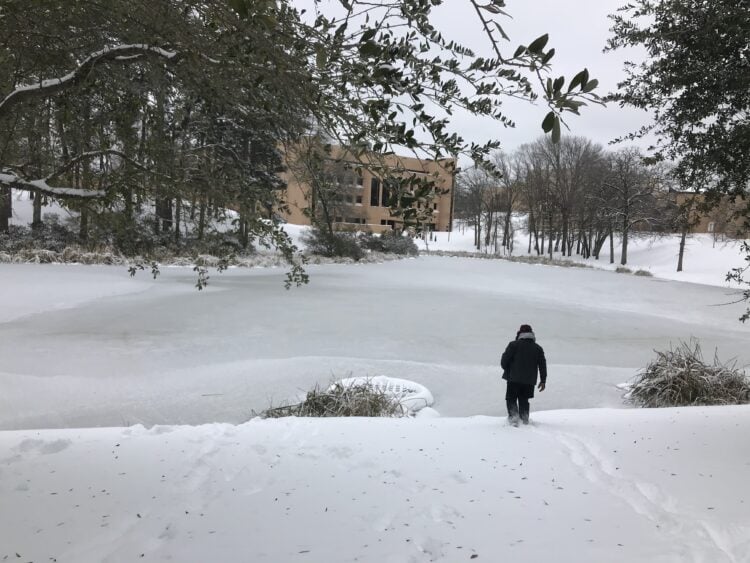
In the first couple days of the storm, my daughter and a small group of friends explored their frozen campus together, making snow angels and checking out the completely frozen-over lake near the science building. She also regularly called and texted her dad and myself, and Facetimed her other friends who were stuck at home or in their dorms, and did YouTube workouts to get some exercise in every day. Her best friend celebrated a birthday during the freeze, so my daughter baked a small loaf of fresh bread and hand-delivered it to her as a gift. She went above and beyond to connect with others and give herself some structure during an unpredictable week.
What This Changed About How I Talk to Her About Preparedness
Instead of focusing on worst-case scenarios or long lists of supplies, I try to keep our conversations practical and grounded in everyday situations — something I’ve always done. We talk about things like what to do if the power goes out for several days, what if her car breaks down on a busy Houston highway, how to stay in touch if phones aren’t working, and where she could go if she needed help.
Chats about preparedness and survival shouldn’t be intimidating or fear-inducing. Being prepared should work to instill confidence, and casual conversations related to current events, like that winter storm, sets the stage and a reassuring tone for practical prepping. I want my daughter and son to view preparedness as a useful life skill, and from my daughter’s experience, I know that lesson has been learned.
COVID and the Lockdown — The Disaster That Didn’t Look Like We Expected
By the time most Americans were panic-buying toilet paper, I had already been watching the numbers coming out of China for weeks. The case counts were growing, and it was clear this was going to reach the United States. I had a friend working with a major hand sanitizer company that was receiving regular CDC briefings, and what she shared with me confirmed what I suspected: this was serious, and it was coming. Pandemic preparedness was no longer just a theory.
Why We Never Touched Our Food Storage
So I got to work, not on food, which we already had plenty of, but on the supplies that are easy to overlook. Hand sanitizer, soaps, detergents, household cleaning products, and OTC medications that would address the symptoms we were hearing about. I added those to our preps before the shelves cleared.
When the lockdowns hit, we had what we needed. And as weeks turned into months, we found ourselves in an odd position: we never actually touched our food storage. Not because we didn’t need to, but because despite some shortages and the occasional empty shelves, the stores generally had enough to get by. We went without certain things here and there, but it never rose above the level of inconvenience. The food storage was there if we needed it, and knowing that made all the difference, even when we didn’t reach for it. I never felt nervous about not having what we needed because we always had that back-up.
Two things did catch me short, and I’ll own them: dog food and tall kitchen trash bags. Neither turned into a crisis, but both were a reminder of how easy it is to stock up on “the big stuff” and completely forget about the everyday non-food items you take entirely for granted until they’re gone.
The Real Value of Being Prepared
What COVID made clear to me is that being prepared isn’t just about the worst-case scenario. It’s about the margins it creates around you when things get uncertain. We weren’t scrambling. We weren’t anxious about whether we’d have enough to eat. We could focus on what actually mattered — keeping our family healthy and helping the people around us think clearly.
We spent a lot of time outside during those months. Bike rides, fresh air, Vitamin C and Vitamin D. Our daughter had to move home from her dorm, which meant the whole family was under one roof again, and we made the most of it. We actually enjoyed it. The chaos that was swallowing so much of the country felt distant from us, not because we were lucky, but because we had prepared.
That preparation also meant I could show up for my readers and Survival Mom Sisterhood members when they needed it most. I held regular video calls, sent consistent email updates, and recorded training videos to help people understand what was happening and what they should do. I created household supply checklists so they could fill in their own gaps before the shelves cleared. Being prepared gave me the bandwidth to help others, and that, honestly, is one of the most satisfying parts of this work.
What the Media Got Wrong and What People Got Right
What I noticed during COVID was that the people who fared best weren’t necessarily the most stocked or the most informed. They were the ones who stayed calm, kept their heads, and didn’t let panic overwhelm them. The 24/7 coverage made that harder than it sounds. Fear was the dominant message, and it was relentless.
What helped our family was having already done the thinking beforehand. Because I had been watching the situation develop for weeks, I saw we had time to prepare and plan — similar to watching a hurricane form out in the Gulf. You know it’s on the way, so you use your time wisely getting ready. That’s a completely different mental state. We knew what we had, we knew what we needed, and we weren’t scrambling. My kids weren’t panicking. My husband wasn’t panicking. Calm is contagious. Whatever happened, we would be ready to meet it.
For my readers and Survival Mom Sisterhood members, I tried to be the calm and trusted voice that spoke up with common sense. Regular video calls, email updates, recorded training, practical checklists. Not fear, there was already too much of that. Just information and action steps. The feedback I got told me that for a lot of people, having someone they trusted say “here’s what’s actually happening and here’s what you can do” made an enormous difference. That, more than any supply list, might be the most important thing preparedness gives you. The ability to be that person for someone else when everything feels uncertain.
What Real Survival Stories Teach Us That Nothing Else Can
A manual can tell you what to do. A survival story shows you what it actually feels like when everything goes wrong — the decisions made under pressure, the things that worked, the things that didn’t, and the moments where the outcome could have gone either way. That’s the kind of education you can’t get from a checklist.
The Questions to Ask While You Read or Listen
The most valuable thing you can do with a survival story is resist the urge to read it passively or purely for entertainment. Instead, treat it like a training exercise. As you read, ask yourself:
- What would I do in this situation. Not in the abstract, but specifically, given my finances, my health, my location, and my family responsibilities?
- Would my current supplies and gear have been enough?
- What would I have needed that I don’t have?
- What would I have done differently?
- Was there a better strategy the survivor missed?
- How could I survive this situation with my specific circumstances in mind?
The goal is to finish every survival story with a clearer picture of yourself in that scenario — your strengths, your gaps, and exactly what you’d need to close them.
Then go deeper. What would I have done differently? Don’t just admire the survivor’s decisions. Critique them. Where did they go wrong? Was there a better strategy? What could they not have known at the time, and what should they have known? This isn’t about armchair judgment; it’s about gathering every possible lesson while the stakes are low and you still have time to act on them.
How to Turn Someone Else’s Experience Into Your Own Preparedness Plan
The mistake most people make is reading a survival story and thinking, I need to do exactly what they did. But one size never fits all in preparedness. This is one of the most important principles and a mistake I made again and again when I first began prepping. A strategy or supplies that worked for a single man in a rural area may be completely wrong for a mom of three in a suburb. Learn from their mistakes, but then filter everything through your own circumstances before it becomes a plan.
Start with the lessons that are universal: stay calm, know your resources, don’t wait until the last minute. Then ask yourself how those lessons apply to your life specifically. What does your version of that survival story look like? What are the variables that are unique to you (so important!) — your neighborhood, your health needs, your budget, the people depending on you? Think of every survival story as a case study you can learn from.
Real Survival Stories from This Community
On This Blog
- Tornadoes: 11 Lessons the Joplin Tornadoes Taught Our Family
- Hurricanes: Survival Diary from 3 Hurricanes
- Power Outage: 9 Days Without Power
- Water Shortage: Smart Ways to Conserve Water During Drought
- Floods: The Nashville Flood
- Housefire: A Housefire Changed My Life Forever
- Storms: Surviving a Powerful Summer Storm
If you love to read survival-themed books, come join Survival Mom Book Club on Facebook!
Books Worth Reading
Recommended by Survival Mom:
- The Unthinkable by Amanda Ripley
- Deep Survival by Laurence Gonzalez
- Will to Live by Les Stroud
- Save Our Souls by Matthew Pearl
- The River of Doubt by Candice Millard
- Into the Abyss by Carol Shaben
Final Thoughts on the Importance of Personal Survival Stories
Checklists and gear lists have their place. I’ve created many of them for different survival scenarios. But they can’t replicate what happens when a real person sits down and tells you exactly what it was like — the moment they realized the situation was worse than they thought, the decision they made under pressure (right or wrong), the thing they wished they had done differently. That’s the kind of knowledge that sticks.
I’ve been collecting survival stories since I was a kid. Decades later, I’m still doing it because I learn something new from every story. The Harvey flood that changed my town forever. Our generator during the Hurricane Beryl power outage that did everything right and still created a dangerous scenario. A daughter alone in a snowstorm, figuring it out. A pandemic that looked nothing like the disaster we had all been preparing for.
Every one of those experiences, mine and others’, changed how I think and how I prepare. That’s the real power of a personal survival story. Not inspiration or entertainment for its own sake, but the kind of specific, human knowledge that actually moves you to act. Seek out these stories. Ask the hard questions while you read them. And when you find the lessons that apply to your life, don’t just file them away, do something with them. Honestly, that’s the very best way to be prepared.
Frequently Asked Questions
Personal survival stories reveal what really happens during a disaster to real people — the decisions made under pressure, the supplies that fell short, the things nobody saw coming. They build a mental library of real human experience that no checklist or manual can replicate.
Both have value, but they serve different purposes. Manuals give you steps; survival stories give you context. Reading about someone who lived through a hurricane, an extended power outage, or a pandemic helps you understand what those situations actually feel like, and that understanding changes how you prepare.
Start by asking what you would have done in their situation, given your specific circumstances: your location, health, finances, and family responsibilities. Learn from their mistakes, identify the gaps their experience revealed, and then customize those lessons to fit your life. One size never fits all in preparedness.
The most useful questions are: What would I have done differently? What gear or supplies would I have needed? Was there a better strategy? And most importantly, could I survive this situation with my current resources and the people depending on me?
This blog has a curated collection of firsthand accounts from survivors of hurricanes, floods, tornadoes, power outages, and more. See links to those articles in the section above, “Real Survival Stories from This Community”. For books, check out our recommended reading list of real-life survival narratives.
I love reading personal survival stories! They always make me feel inspired and motivated to keep going in the face of adversity. Thank you for sharing these stories!