

Check your spare change jar. The one on the dresser, or the coffee can in the closet, or the old pickle jar that somehow became the family coin dump. Odds are, if it’s been filling up for a few years, you’ve already got a few dollars’ worth of real silver sitting in there, and you’ve been treating it like pocket change.
That’s the whole idea behind junk silver. And once you understand it, you’ll never look at a pile of old coins the same way.
This article has been completely updated with the current pricing for silver and additional tips. April 2026.
In This Article
What Is Junk Silver?
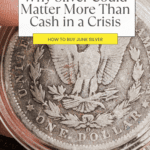
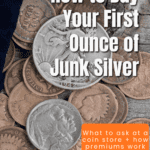
Junk silver refers to U.S. coins — dimes, quarters, half dollars, and dollar coins — minted in 1964 or earlier. These coins were made with 90% real silver. The ones circulating today? Mostly zinc and copper sandwiched together with a thin outer shell. No real metal value at all.
The word “junk” is a coin dealer’s term meaning the coins have no special collector value. They’re worn, common, and not rare. But that’s actually a good thing, because what you care about isn’t the coin, it’s the silver inside it.
A pre-1964 Roosevelt dime isn’t worth 10 cents. At current silver prices, it’s worth somewhere in the neighborhood of $5 to $6. A Washington quarter from 1963? Closer to $13 to $14. A pre-1965 Kennedy half dollar? Around $27.
And that’s just for a single coin.
In general circulation, though, few of these silver coins can be found.
Some of the links in this post may contain affiliate links for your convenience. As an Amazon Associate, I may earn a small commission from qualifying purchases without any increase in price to you.
Why Preppers Care About Junk Silver
Silver has served as real money for most of human history. Paper currency is only as good as the government backing it. Physical silver doesn’t need anyone’s promise. It has intrinsic value that’s recognized globally, and it always has.
For preppers, and really for anyone with a concern about the value of the dollar, junk silver makes sense for several overlapping reasons.
It’s a hedge against inflation. If you watched the price of groceries climb in recent years and thought, “I wish I’d done something to protect my savings,” silver is one of the tools people use for exactly that purpose. It doesn’t track with the dollar. When the dollar loses purchasing power, silver often gains, which provides some assurance when you’re trying to live as frugally as possible.
It’s fractional. This is the big one. A one-ounce silver bar is hard to use for small transactions. It’s like trying to buy a loaf of bread with a $100 bill. Junk silver comes in small denominations. A silver dime, a silver quarter, a silver half dollar. You can make change. You can trade in small amounts. That’s enormously practical in a barter or disruption scenario.
It’s universally recognizable. Every American over a certain age knows what an old dime or quarter looks like. They were in circulation for decades. In an emergency, you’re not trying to convince a skeptical stranger that your silver bar is legitimate. You’re handing them a coin they’ve seen their whole life.
It’s hard to counterfeit. Modern silver bars and coins get faked. Junk silver coins are too small, too common, and too low-value individually to be worth counterfeiting. They were minted by the U.S. government and have a distinct look, feel, and sound.
It’s a financial backup, not just a collapse scenario. Here’s the framing I think makes the most sense for regular families: junk silver is emergency savings in a form that isn’t dollars. Job loss. Medical bills. A stretch of hard times. You can sell silver coins to a coin dealer any day of the week. You don’t need the grid to go down for it to be useful.
What’s Junk Silver Worth Today?
Silver has moved a lot in recent years. As of early 2026, silver is trading around $75 per troy ounce. This is a massive jump from the $18/oz price this article originally quoted back in 2015. That changes the math significantly.
Here’s a rough breakdown of what common junk silver coins are worth at today’s prices:
| Coin | Silver Content | Approximate Value |
|---|---|---|
| Roosevelt Dime (pre-1965) | 0.0715 troy oz | ~$5–6 |
| Washington Quarter (pre-1965) | 0.1788 troy oz | ~$13–14 |
| Kennedy/Franklin Half Dollar (pre-1965) | 0.3575 troy oz | ~$26–28 |
| Kennedy Half Dollar (1965–1970) | 40% silver, 0.1479 troy oz | ~$11–12 |
| Morgan/Peace Silver Dollar (pre-1936) | 0.7734 troy oz | ~$57–60 |
These are approximate melt values based on ~$75/oz spot price. Actual prices from dealers will include a premium. Use Kitco or Coinflation to check current values before buying or selling.
A useful rule of thumb: $1.00 in face value of 90% junk silver coins equals roughly 0.715 troy ounces of silver. At $75/oz, that $1 face value is worth about $53.60 in actual silver. A pre-1965 quarter still marked “25¢” is worth fifty times its face value in silver today.
That’s not a typo.
Which Coins to Look For
The most common and most useful junk silver coins are:
Roosevelt Dimes (1946–1964). Small, easy to handle, great for small transactions. Any dime minted 1964 or earlier is 90% silver.
Washington Quarters (1932–1964). The workhorse of junk silver. Very common, easy to find at coin shops.
Franklin Half Dollars (1948–1963) and Kennedy Half Dollars (1964). Larger denomination, less common, but good to have.
Kennedy Half Dollars (1965–1970). These are 40% silver, not 90%. They have some value but are worth less per coin. You can spot them by looking at the edge. 90% silver coins have a solid silver edge; 40% halves show the copper alloy layering.
Morgan and Peace Dollars (pre-1936). Beautiful coins with solid silver content. More expensive to buy since they’re recognizable and desirable. Good to own, but they come at a higher premium.
What about nickels? Regular nickels aren’t silver except for the “War Nickels” minted from mid-1942 to 1945. Those contain 35% silver. Look for a large mint mark above Monticello on the reverse. Worth checking for, but not the priority.
How to Spot a Silver Coin
Checking mint dates is the easiest method. Anything 1964 and earlier for dimes and quarters, 1964 and earlier for 90% halves.
But here’s a sensory trick that works once you know it: drop a silver coin on a hard surface. It rings. Not a dull thud like modern coins. It will have a clear, high-pitched musical tone. Once you’ve heard it a few times, you’ll recognize it immediately. Go to a coin shop and ask to hear the difference. It only takes once.
Weight is another tell. Silver is denser than the copper-nickel clad coins minted today. A pre-1965 quarter feels noticeably heavier.
How to Buy Junk Silver (Without Getting Ripped Off)
Local coin shops are the best starting point, especially if you’re new. You can see the coins, ask questions, and compare prices. Ask what their premium is over spot — that’s the markup above the raw silver value. A typical premium at a reputable shop runs 5–15% over melt value. Higher than that, keep shopping.
Once you find a coin store where the pricing is fair, the owner and employees take time to answer your questions, then become a regular.
Online dealers like APMEX, JM Bullion, and Gainesville Coins have competitive pricing and wide selection. Good option once you know what you’re looking for. Read reviews and check the current spot price before buying so you know what a fair premium looks like.
Coin shows can be a great source of below-market deals. Bring cash.
Yard sales, estate sales, and antique shops occasionally turn up junk silver from sellers who don’t track spot prices daily. This is where you can find genuine bargains.
Your own change. It’s increasingly rare, but silver coins do still surface occasionally in circulation. Get in the habit of checking mint dates on dimes and quarters before dumping them in the jar.
Don’t pay collector premiums for junk. If a coin is being priced for its rarity or condition, it’s no longer junk silver in the preparedness sense — it’s a collectible. You want coins priced near melt value.
How Much Should You Buy?
Think of junk silver like a layer of your overall preparedness plan — not the foundation. Food, water, and fuel come first. Silver is a financial layer, not a survival layer. You can’t eat it and you can’t drink it.
That said, even a modest start is meaningful. A few rolls of pre-1964 dimes from a coin shop is a legitimate first step. Over time, adding a little at a time, especially when silver prices dip, builds a real position.
Some preppers aim for a “face value” goal: $50 or $100 in face value of 90% junk silver as a starting point. At today’s prices, $50 face value is roughly $2,680 in actual silver value. That’s a meaningful financial cushion that doesn’t rely on any bank, broker, or app.
I like this idea because it helps you focus on the face value, something you’ve set for yourself, and then you can easily watch that value increase with each purchase.
Store it somewhere safe, in more than one location, and keep the information to yourself.
Junk Silver For The Kids
A couple of years ago, my brother-in-law took all his nieces and nephews aside and handed each a silver round. My son was so taken by that — totally impressed — and it was the start of his own silver collection.
Both junk silver and silver rounds are easy gifts, and until very recently, fairly budget-friendly as well. No one knows what the future holds for the price of silver, but as a precious metal, it will always hold some value.
For the next birthday, Christmas, or a just-because gift, consider giving the young people in your life a bit of real, genuine silver.
Note: I’m not a financial advisor. This isn’t financial advice. It’s preparedness information. Do your own research and make decisions that fit your situation.
FAQ: Junk Silver for Preppers
It depends on what you mean by investment. If you’re expecting silver to outperform stocks over the long term, history suggests it won’t — the S&P 500 has dramatically outpaced silver over decades. But junk silver isn’t really an investment in that sense. It’s a hedge, a financial backup, and an alternative to holding everything in dollars. Think of it as one layer of a diversified preparedness strategy, not a wealth-building vehicle
Any local coin shop will buy it. You can also sell to online dealers, but local is simpler and faster. Expect to receive slightly below spot price — dealers buy low and sell at a small markup. Don’t go to a pawn shop if you can avoid it; they typically pay the least
Stick to U.S. government-minted pre-1965 coins from reputable dealers, and junk silver is essentially impossible to fake effectively. The ring test, the weight test, and checking the edge for the copper sandwich layer are all useful verification methods. For coins costing more — like Morgan dollars — a small jeweler’s scale to verify weight is worth having
Technically, the U.S. government did require citizens to surrender gold in 1933. Silver was not included. There’s no modern law requiring silver to be surrendered, and junk silver’s status as legal tender (it still is, technically) complicates any confiscation scenario. This is a real concern worth understanding, but it shouldn’t stop you from owning silver — it should inform how you think about it as one part of a broader financial prep
Bullion refers to silver bars, rounds, or modern government-minted coins (like American Silver Eagles) with very high purity — usually .999 or higher. Junk silver is 90% pure, which means it’s not IRA-eligible and carries some copper content. The tradeoffs: junk silver is often cheaper per ounce (lower premiums), more recognizable for barter, and comes in convenient small denominations. Bullion is higher purity and can be cleaner to trade with dealers. Many preppers own both.
No. This is preparedness 101 — operational security applies to precious metals just as it does to food storage. Don’t post about it, don’t discuss it casually, and store it discreetly.
Thanks, Mom.
Hey, another good source you might want to provide your readers is the Silver Coins Value page at Coinflation.com (one of my favorite bookmarks). There’s an up-to-date table of junk silver values there, as well as a calculator folks can use to check the value of their individual silver coins. Each link in the table takes the reader to a page where he/she can view the history and metallic composition of the coin series (e.g., Mercury dimes), as well.
Thanks again,
Jack
I don’t think so. I haven’t found a silver coin in my change in decades.
Good idea. Folks should also check their pennies as pre 1983 are copper. Commodities will have value in a collapse scenario. Also the Nickel in nickels pre 2011. This post from survival blog is helpful.
http://survivalblog.com/nickels/. I am of the mind that metallic coins have a value that paper does not.
I have been going through my change for 3 years. I use mostly cash for my purchases so I get a lot of change back over time. I have yet to find a silver dime, quarter, half dollar, or dollar. I did find a silver certificate (paper of course) and a war nickel.
I still like the article because it motivates people to use cash instead of plastic. When people buy things with credit cards, vendors raise their prices to pay the fee. Using cash also helps people save their money. I have emptied out my jug a few times to pay down the principal on my student loans.
I also like how the article helps educate people on silver, which of course is real money. I have given silver coins to my family and friends. While they appreciate the gift, they still don’t realize silver’s value. That’s why I started making candles with silver coin prizes.
They are excited to see what their prize is worth and will research silver on their own. They learn that a silver coin is worth 12-20 times its face value! Also, like the article says, once you hold real silver, its easy to see that it is real money, not like the zinc counterfits circulating today.
Don’t forget to check for pennies minted in 1982 (some) and before. These contain copper not the mildge in todays pennies. Also nickels are good to save as well. They contain metal that at one time was worth more than a nickel. I don’t know about today, but still a nickel will likely be worth something more than a nickel if the economy goes North.
Go to the bank and get some rolls of dimes or quarters, and you might find a winner in there! I found a war nickel in my change, about a month ago, and there are more treasures to be found. Be sure to check your change every night and you will be surprised at what you have accumulated. The weak economy means that more people are cashing in their old coins, so keep your eyes (and ears) peeled (listen for the tell-tale clink)– who knows WHAT you might unearth!
With junk silver will be easier to trade than having the 1oz. silver coin. But don’t get me wrong what the mind set will be is how many silver coins is it going to take get a car!
I’m with Bobster…I haven’t gotten a silver coin in change in at least 10 years [and even very rarely back 40 years ago when i was a paperboy – maybe one every 2-3 weeks then]. Most people who use cash are too aware of silver coins to let one slip by. Haven’t seen a silver certificate in the same 10 years, either. I used to get one of those every 1-2 months as a kid.
Great breakdown! Junk silver is such an underrated entry point into precious metals. I like how you emphasized it’s not about the collector value but the real silver content. I’ve been building my stash over time, and one of my go-to sources is BOLD Precious Metals—they offer competitive pricing and reliable service for pre-1964 U.S. junk silver. For anyone prepping or just starting with silver, this is a smart and affordable way to begin stacking. And yes—the sound of real silver coins? Totally unmistakable once you hear it!